


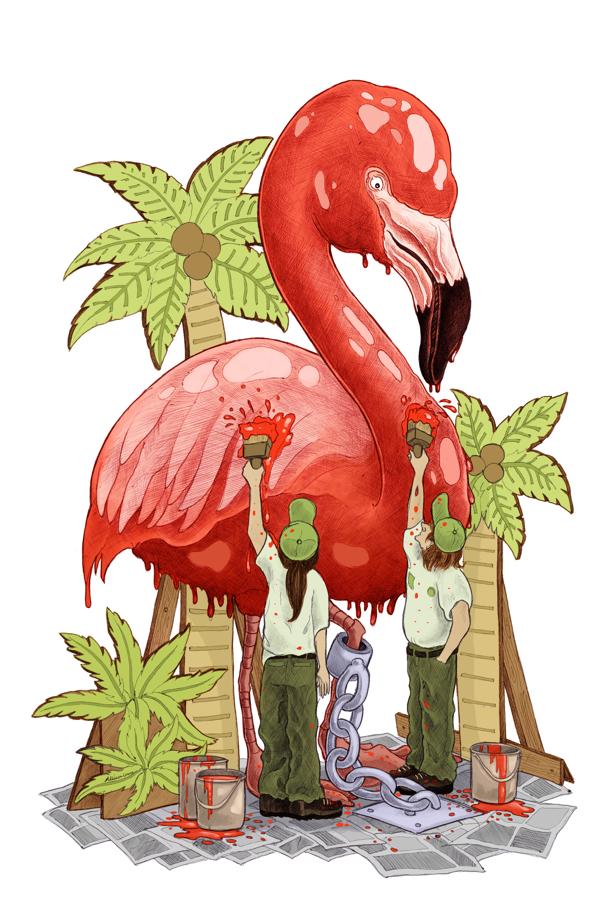
Everyone knows flamingos are pink. Many people know flamingos are pink because they eat shrimp, which are packed with beta-carotene, a pigment that has the side effect of changing the color of the birds’ feathers.
Lesser known is the fact that most flamingos in zoos don’t eat shrimp; they eat grain pellets. These flamingos are perfectly healthy, but, without a steady intake of shrimp, their feathers become white instead of pink.
Does that seem unnatural? It does to a lot of zoo visitors, which is why zookeepers have begun supplementing captive flamingos’ grain pellets with beta-carotene to create “a kind of aviary costume for their public performance as ‘wild’ pink birds,’’ writes sociologist David Grazian in his book “American Zoo.’’
Flamingos are one example that Grazian, an associate professor at the University of Pennsylvania, uses to turn our common understanding of zoos on its head. Zoos aren’t places urban-dwelling humans go to see nature, he argues — they’re places we go to invent nature.
Ideas talked to Grazian by phone from his home in New York City.
Below is an edited excerpt.
IDEAS: Most people think zoos simply bring nature into a space where humans can learn about it. Is that wrong?
GRAZIAN: Can nature be considered something distinct from the human world of civilization? Certainly, in the climate change era, there’s not a single inch on the planet that has not been shaped or transformed by centuries of human activity, from our fossil fuel use to our production of livestock to our use of nuclear weapons.
There is no place where one can go where animals are free from human domination. The only patches of wilderness left in the world are places that are maintained and regulated by governments.
IDEAS: And this comes to the forefront at zoos?
GRAZIAN: Zoos are cultural representations of the natural world, like theatrical stages. The joint work of zookeepers and their animal charges are performances, where audiences invest these performances with meaning and value and sentiment.
When people go to the zoo, they want to see animals performing their natural behaviors, even though those behaviors are typically based on perfected images and fantasies that humans have about the natural world rather than the actual scientific and biological realities of animal life. For instance, the African lion rests 20 hours a day, but most visitors’ sense of what a real lion is, is this ferocious animal that roars. So people at the zoo will approach sleeping lions and bang on their glass cages in hopes that they’ll wake up and behave like Simba from “The Lion King.’’
IDEAS: Why are we conditioned to want this?
GRAZIAN: The first American zoos were developed at the height of the Industrial Revolution, when more and more people were moving to cities. Fewer and fewer people were working in agriculture. People became further and further alienated from the rural countryside and the animal kingdom.
Humans today very rarely interact with animals. Most of the animals they interact with are their own domesticated pets. And the animals they see in the wild they see in heavily edited nature documentaries or on Animal Planet, the TV channel. People have expectations of what the natural world is going to look like and zoos very often cater to those fantasies as opposed to showing the realities of life in the wild, warts and all — what includes everything from what animals eat to how often animals die.
IDEAS: How does that shape zoos?
GRAZIAN: Because the zookeepers spend so much time around the animals, they know what animals enjoy, what excites them, what calms them down. Although people may appreciate exhibits that have elaborate tree plantings and carefully constructed rock formation built out of concrete, the zookeepers know that the animals don’t really care. For enrichment, they give the animals everything from children’s toys to beer kegs, and they like them just fine. The naturalistic elements are more there for the visitors than actually for the animals.
IDEAS: Kids and parents sometimes have very different experiences at zoos. Why?
GRAZIAN: Children experience the zoo in a much freer and exciting way. For instance, children at the zoo are always entertained and amused at the sight of “fill’’ animals that happen to roam the zoo grounds, whether they happen to be squirrels or pigeons or even pests like mice. Parents will argue with them: “We didn’t come to the zoo to see a squirrel because they’re so ordinary.’’
But the child is very conscious of the fact that the squirrel is actually a wild animal, is actually free, as opposed to the animals in the cages. The children have also not yet become socialized to value certain animals over others, so they tend to have a general appreciation for the animal kingdom.
It’s something that kids get that the parents don’t. The parents have been socialized to value exotic animals from all over the world over the very ordinary animals that live in their own backyards and are actually part of the ecosystems and natural habitats in which they actually live.
IDEAS: What duty do zoos have when it comes teaching visitors about conservation?
GRAZIAN: There are no Democratic and Republican zoos. They attract religiously devout and secular people. They attract people from all social classes and ethnicities. Because people are primed to experience the zoo as an educational place to learn about the natural world, zoos potentially have a very strong role to play in educating the public about global warming and climate change mitigation and adaptation.
I find it so disappointing how little zoos do to actually lead on these kinds of environmental issues. One way that zoos do this is when they discuss climate change, they discuss it as a kind of crisis without a cause. They’ll highlight rising sea levels and rising average global temperatures, but they won’t attribute these planetary changes to human activity. And when they do, they attribute the problem to consumers as opposed to automobile manufacturers or gas and oil companies or large agricultural multinationals.
IDEAS: Or they attribute it to far away individuals, like during a theme park helicopter ride you describe taking with your son.
GRAZIAN: One of the things that Disney does during one of its safari tours through an ersatz African continent is it tries to illustrate the problem of poaching in the wild by deputizing the safari riders as enforcers of international laws concerning the poaching of wildlife and particularly endangered animals.
While poaching is an obvious problem, particularly in parts of the world where rhinoceros horns and elephant tusks are valued, it’s telling that of all the environmental problems to focus on, Disney World chooses to focus its attention on a problem that most Americans don’t identify as being the cause of. It’s also a problem that can be attributed to indigenous people, as opposed to either ordinary Americans or multinational corporations.
IDEAS: How do zookeepers feel about all that?
GRAZIAN: Zoo staff that I spoke with were all fairly adamant about the fact that if zoos don’t educate the public, then they have no right to put them on display for gawking audiences. One person said, if we can’t use zoos to educate the public, then we’re nothing more than a Chuck E. Cheese with animals.
IDEAS: It sounds like that might be what visitors want.
GRAZIAN: Zookeepers do think that this is what the majority of audiences want. But what gives them faith is the occasional visitor or audience member that is attuned to climate change issues or deigns to learn more about these animals.
Zoos are such powerful institutions, and animals in the natural world have the potential to open minds so much that zookeepers realize that they always have the potential of touching the heart of a parent or a child. And it’s that sort of optimism through experiencing these really terrific interactions with certain families that gives them the optimism to keep going and makes them feel like the zoo experience is worth saving, because it can be so worthwhile.
Kelly O’Brien can be reached at kelly.obrien@globe.com.

