


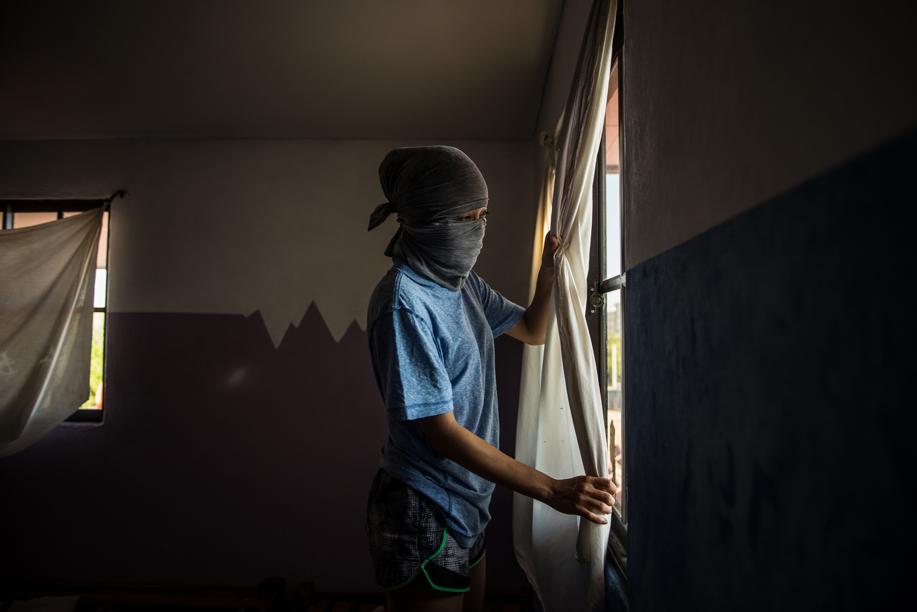
The patio is cluttered with mattresses and suitcases, clothes spilling out of them. Sheets separate families from strangers, gentlemen from ladies.
Women cook over an open fire fueled by freshly cut wood because the kitchen in this modest three-bedroom ranch home in the Costa Rican countryside cannot possibly accommodate food preparations for 50 hungry fugitives.
This is a secret safe house for Nicaraguan protesters who are trying to avoid capture by the country’s authorities. It was not designed for crowd comfort.
Even though the ranch is across an international border, those living here take turns on nightly guard duty, concerned about agents from Nicaragua infiltrating their haven.
The woman who runs the refuge, who goes by the pseudonym “the Godmother,’’ looked around while a compatriot slammed a machete against a tree stump to cut more firewood.
“We consider our stay here to be temporary,’’ she said. “We are tired already. We want to go home.’’
The Godmother’s real name is Lisseth Valdivia. She used to own three clothing stores in Matagalpa, a city north of Nicaragua’s capital, Managua. A 39-year-old mother of two, she liked working out at the gym. She rode a new scooter. She was earning a decent living.
Then her life, and the lives of tens of thousands of other Nicaraguans, were upended in April, when first the elderly, and then the young, took to the streets to demand the removal of the president, Daniel Ortega, and his wife, Vice President Rosario Murillo.
Many Nicaraguans long viewed Ortega, in office since 2007, as increasingly dictatorial. But what finally drew masses of demonstrators to the streets were wildly unpopular social security cutbacks.
The police and progovernment mobs responded with deadly force, even against unarmed protesters, human-rights observers say, shooting and killing people across the nation.
Valdivia said she wondered why nobody helped them. First one fell in her neighborhood, then a second. After the third was shot, she hopped on her new moped and came to their assistance herself.
Valdivia spent two months running what she considered a humanitarian command post, administering first aid and providing lunch to protesters who were snarling traffic with improvised road blocks. She learned how to use homemade mortars, she said.
Then a relative phoned with a warning: “Don’t even think of coming here. There are about 25 police officers in your house, and they are destroying it.’’
She fled and never looked back, leaving behind three shuttered businesses, a house, a car, the scooter — and, for his own safety, her 7-year-old son, put in the care of his father, who has sided with the government and sometimes sends Valdivia angry text messages about her allegiances.
“For now, I have to be with my people,’’ she said, referring to her fellow fugitives. “In the future, when Nicaragua is free, my son is going to enjoy all of that.’’
In the Nicaraguan government’s version, the protesters are terrorists and murderers.
By the summer, the government regained the upper hand. In July, the Nicaraguan police, with assault rifles blazing, demolished more than 100 roadblocks. Activists were arrested at their homes and hiding spots around the nation.
At least 565 people are still jailed, some of them on murder charges and others for what the government calls terrorism. Another 23,000 people, like the Godmother, retreated to neighboring Costa Rica.
Also, a Nicaraguan Supreme Court justice who was Ortega’s closest legal adviser before he resigned last week accused the president and his wife of running a brutal government that tramples on civil rights and is driving the nation to the brink of civil war.
The justice, Rafael Solis, spoke to The New York Times after his resignation Thursday, which marked the highest-profile defection yet in the country’s nine-month-old political crisis. Government critics said it signaled a possible weakening of the political apparatus that has helped keep Ortega and his wife, Vice President Rosario Murillo, in power long after hundreds of thousands of people took to the streets demanding their ouster.
Solis was unsparing in his criticism of Ortega, with whom he had been allied since the 1970s.
“The separation of powers in Nicaragua is over,’’ he said. “The concentration of power is in them, those two people.’’

