


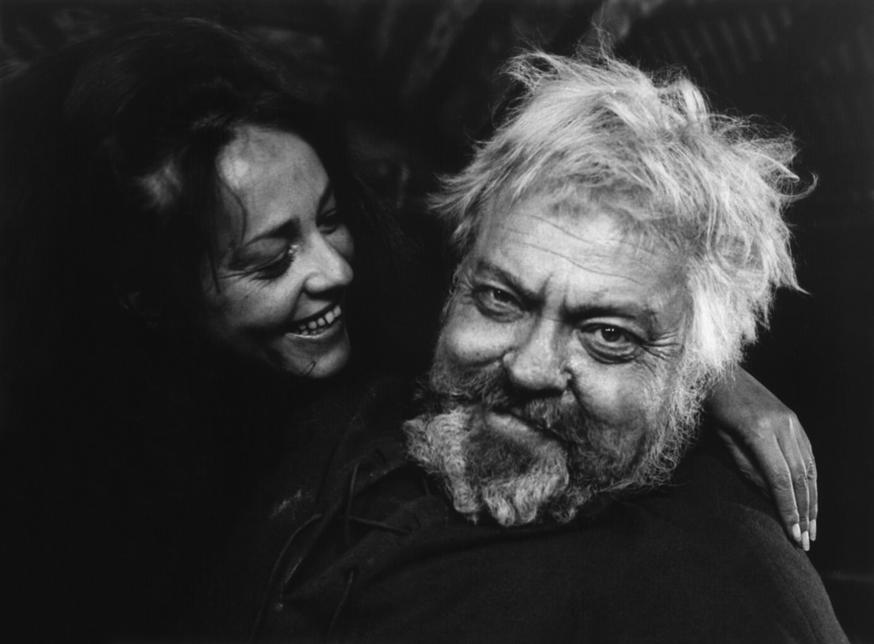
First there was the arduous and financially challenging shoot. Then “Chimes at Midnight,’’ the 1965 historical drama that is counted among Orson Welles’s masterpieces, had a hard time being seen.
For decades after its release, which did not happen in the US until 1967, it was rarely shown in theaters and difficult to find on video. Due to legal disputes over rights, DVD distribution was perpetually on pause.
Now, at last, comes the reissue of “Chimes’’ in a newly restored version that caps a 20-year effort by Janus Films and the Criterion Collection. Audiences can see it Monday at 7 p.m. at the Coolidge Corner Theatre as part of the Big Screen Classics series.
Welles directed and stars as Sir John Falstaff, the larger-than-life comic character that Shakespeare introduced in “Henry IV,’’ parts I and II, and who also makes an appearance in “The Merry Wives of Windsor.’’ Welles’s adaptation gives Falstaff a plot all his own. Set in the 15th century, Falstaff carouses with Prince Hal (Keith Baxter), the young Prince of Wales, to the chagrin of Hal’s father, King Henry IV (John Gielgud). Hal’s defeat of the rebel Harry Hotspur at the battle of Shrewsbury leads to Hal’s coronation as Henry V and his banishment of Falstaff.
Welles shot the independently financed “Chimes at Midnight’’ in Spain, with a cast that includes Jeanne Moreau, Margaret Rutherford, and narrator Ralph Richardson. It was shown at the 1966 Cannes Film Festival, where it was well-received by most of the audience. But influential critic Bosley Crowther of The New York Times panned the film, effectively dooming its release.
Many critics later hailed the adaptation as one of Welles’s highest achievements and Welles called “Chimes at Midnight’’ his best work.
For more information go to www.coolidge.org
Ticket to ‘Paradise’
Also providing audiences with the chance to see neglected classics on the big screen is the Somerville Theatre’s “Silents Please!’’ series. On Sunday at 2 p.m., the series offers a rare 35mm print from the Library of Congress of the 1925 comedy “Paths to Paradise,’’ which stars Raymond Griffith, accompanied by live music from New Hampshire-based silent film composer Jeff Rapsis.
Since most of his many silent-era films have been lost, the Boston-born Griffith is largely forgotten today. But his box office popularity in the 1920s rivaled that of Charlie Chaplin and Buster Keaton, according to Rapsis’s website. A childhood injury to his vocal chords left him without the ability to speak above a whisper, so Griffith’s on-camera career ended with the advent of talkies.
In the Clarence Badger-directed “Paths to Paradise,’’ Griffith plays a suave con man who competes with a jewel thief (Betty Compson) to steal a heavily guarded diamond necklace. Also on the program are two silent short comedies: “Two Tars’’ (1928), starring Stan Laurel and Oliver Hardy, and a rare Laurel comedy, “Smithy’’’ (1924), made before he teamed with Hardy.
For more information, go to www.somervilletheatreonline.com
The boy from Brazil
Belmont World Film’s 15th annual international film series presents its closing night film, “Casa Grande,’’ directed by Fellipe Barbosa, on Sunday at 7:30 p.m. at the Studio Cinema in Belmont.
Race and class privilege among Rio de Janeiro’s decadent elite factor into a story about a teenage boy’s struggle to escape his overprotective parents, who are secretly spiraling into bankruptcy. A post-screening discussion will be conducted by Harvard University doctoral student Ana Paula Hirano, who co-produced and co-directed the documentary “From Brazil to Japan,’’ about the many Brazilians who have migrated to Japan and the social and economic impact it has had on both countries.
For more information, go to www.belmontworldfilm.org
Loren King can be reached at loren.king@comcast.net.

