


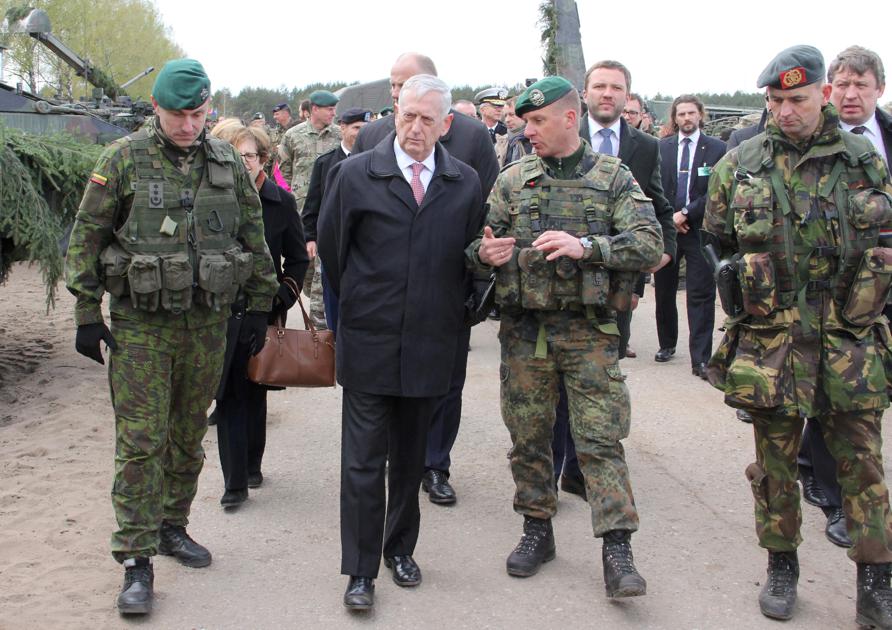
PABRADE, Lithuania — If a shooting war ever breaks out between Russia and the NATO alliance, it could well be in a place like Pabrade, a little town near the edge of a little nation. But a different sort of conflict, waged with bytes rather than bullets, is already being fought here.
Jim Mattis, the US secretary of defense, visited this Lithuanian town Wednesday to see how NATO is faring in that fight, and his guide was a German officer who has been a target in that war, falsely accused of being a rapist and a Russian spy.
“What’s the spirit of your troops?’’ Mattis asked, walking past camouflaged tanks as soldiers with green-painted faces stood at attention.
He was assured by his guide, Lieutenant Colonel Christoph Huber, commander of the German battalion that recently took up station here, that morale could not be higher.
Huber and his soldiers have been the subjects of two recent cyberattacks: false claims of wrongdoing that officials believe were put in circulation by an increasingly aggressive Russian intelligence operation that is meant to sow doubts and resentment of NATO’s growing presence in the Baltics.
The first attack came Feb. 14. E-mails sent to the president of the Lithuanian Parliament and various media outlets falsely claimed that German soldiers had raped a girl. The story rippled through the country before the police determined it was untrue.
A few weeks later, another series of e-mails circulated with what seemed to be photos of Huber among a group of Russian partisans. The photos were faked.
Then, in early April, came a phony story about a supposed chemical assault on US troops in nearby Estonia, which appeared mysteriously on a popular Lithuanian news site.
How did it feel to be the target of these attacks? Huber shrugged. “We don’t know for sure who was behind it,’’ he said. “But we take everything in the information environment quite seriously.’’
Darius Jauniskis, director general of Lithuania’s intelligence agency, said that part of the country’s response to the incidents had been to openly discuss Russia’s efforts to undermine the NATO mission in the country.
“We cannot remain silent and say everything’s all right,’’ Jauniskis said in a conference room in his agency’s headquarters in Vilnius, the capital. “We need to talk about that, so that the people and leaders know the threats are real.’’
Jauniskis and other Baltic leaders have been warning their counterparts in the West for several years about the growing menace they saw from Russia. Their warnings were often dismissed as alarmist. But after the apparent Russian efforts to influence elections in the United States, France and elsewhere, no one needs convincing any more.
“We can’t be glad that we were right all along,’’ said Raimundas Karoblis, the Lithuanian defense minister. “It’s not always comfortable to remind people we’ve been telling them about the Russians for years.’’
Part of Mattis’s reason for visiting the Baltic region was to reassure allies who were rattled when President Trump said the NATO alliance was “obsolete’’ and suggested the United States might protect only countries that had “fulfilled their obligations to us.’’
Standing with President Dalia Grybauskaite of Lithuania at the presidential palace on Wednesday, Mattis said, “Have no doubt that we stand with you united in a common cause.’’
Grybauskaite described Mattis as “a good friend of Lithuania,’’ saying that “he understands the threats facing us’’ and that “we can trust him.’’
During his Senate confirmation hearings, Mattis described the NATO alliance as essential. But he has also said since then that the amount of American support for the alliance could depend on whether other member countries meet their commitments on military spending. In that regard, the Baltic nations “rightly stand as an example for all NATO allies,’’ Mattis said, because they have rapidly expanded their military budgets.
The actions of President Vladimir Putin of Russia in Ukraine and elsewhere have left the Baltic nations deeply uneasy, prompting them to call on NATO to fortify its defenses against a possible Russian invasion. The alliance responded by stationing four additional battalions in the region, one in each of the three Baltic nations and one in Poland.
A parade of prominent Americans, including Senator John McCain, Republican of Arizona, have visited the Baltics in recent months to offer reassurances, but Mattis’s visit was the most eagerly awaited. “It’s a historic visit,’’ said Karoblis, the defense minister.
He and other Lithuanian officials said they were hoping for a promise from Mattis for a permanent US military presence and a Patriot missile battery to bolster the country’s air and antimissile defenses.
The alliance is expected to conduct a large air defense exercise in Lithuania in July, and Pentagon officials have said that a Patriot battery could be moved into the region as part of that exercise, but that the deployment may be temporary.
Mattis was asked by a reporter about the Patriot missiles, but said only that “the specific systems that we bring are those that we determine are necessary,’’ and that decisions would be made in consultation with the Lithuanian government.
Grybauskaite made clear that Lithuanians would welcome such a deployment.

