


I suppose the fact that, this year, they were arguing about the route of the St. Patrick’s Day parade in South Boston, as opposed to who marches in it, amounts to progress.
Up until last year, it was a big deal that gay people were not allowed to express their sexual identity alongside their ethnic identity. Now that bridge has been crossed and there’s no going back.
It is tempting, and maybe even a little bit true, to suggest that the fury parade organizers expressed after Mayor Marty Walsh and Police Commissioner Bill Evans tried to shorten the route was a subconscious reaction to seeing, and being unable to control, so much change in their neighborhood.
The parade organizers, like others who grew up in South Boston, are uneasy about the new Southie, where condos grow like mushrooms, where modest neighborhood watering holes are replaced by themed gastropubs with exposed brick and downtown prices, where it costs more to get your dog’s hair cut than a men’s regular at Figaro’s, where parking is mostly an aspiration.
Southie’s identity is changing, no doubt, but all identities do. The parade is ostensibly about celebrating Irishness and a military tradition that on St. Patrick’s Day 1776 saw the British fleet sail out of Boston as an array of cannon stared down at them from Dorchester Heights.
Now the only ones barred from marching in a parade organized by veterans are other veterans, veterans who identify more with peace than war.
Identity — ethnic, sexual, religious, neighborhood — is a constantly evolving concept. As we age, those various identities take on more or less meaning.
Consider how much Irish identity in this town has changed. It used to be very narrowly defined. You had to have, at the very least, an Irish surname or a granny from Galway. You had to be Catholic. But it wasn’t always like that, and it isn’t like that now.
The other night, Heather Humphreys, the Irish government Cabinet member overseeing the centenary commemorations of the 1916 Easter Rising, spoke at the Charitable Irish Society’s 279th annual St. Patrick’s Day dinner in Boston. She is Protestant, a Presbyterian, as were many of the founders of the Charitable Irish, long before the potato blight of the 1840s transformed Boston from a mostly Protestant town where people traced their roots to England to a city where Irish Catholics were the biggest group.
“Irish identity has changed considerably in the last 20 years,’’ Humphreys told me. “Not just in Ireland, but in America. It’s a lot more inclusive.’’
Colm Tóibín, the author of “Brooklyn’’ and one of Ireland’s most prominent writers, teaches at Columbia University. He considers it significant that he and other Irish writers — Paul Muldoon at Princeton, Eavan Boland at Stanford — are teaching in English departments, and not just at universities like Boston College and Notre Dame with long traditions of Irish studies programs.
“We’re trying to break up the notion of identity, rather than form it,’’ Tóibín said, sitting in Zaftig’s, a Jewish deli in Brookline. “Expand it rather than limit it.’’
As a gay man who happens to be Irish, and an Irishman who happens to be gay, Tóibín said last year’s referendum in which 60 percent of voters approved same-sex marriage in Ireland was the most empirical example of changing identity. But he thinks the peace process in Northern Ireland was a huge catalyst in forcing people to think about ending the policies and politics of exclusion.
“We had to revisit the whole idea of what being Irish was as part of the peace process,’’ he said.
Expanding identity so it becomes more inclusive, less exclusionary, promotes change in other spheres.
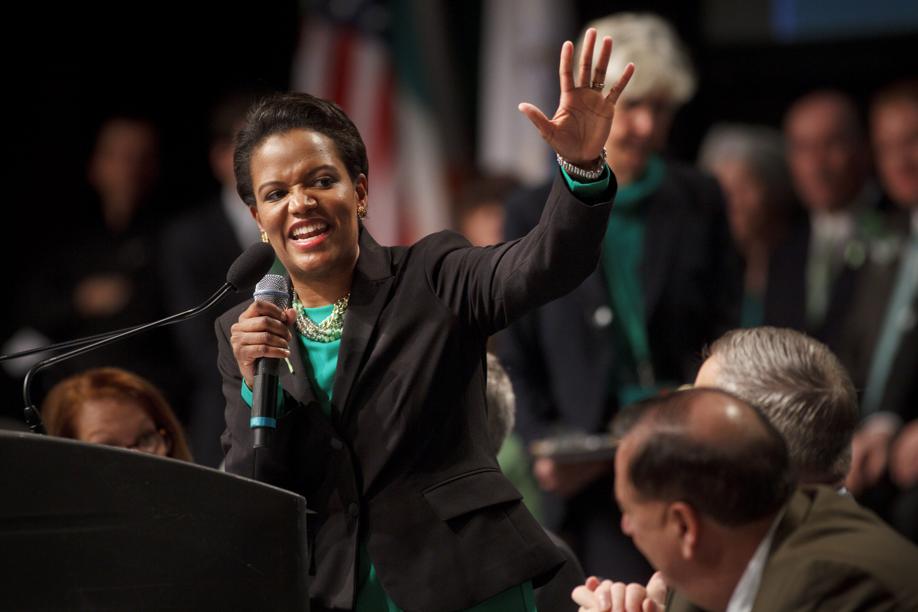
When Charlie Baker watched Linda Dorcena Forry, the state senator, take over the St. Patrick’s breakfast/political roast a couple of years ago, it had a profound effect on him.
“I thought that if a Haitian-American woman could run the St. Patrick’s breakfast,’’ he said, “then a Republican could become governor of the Commonwealth.’’
Dorcena Forry married into a big Irish-American family from Dorchester, proving that old claim by the late Bruce Bolling, the first African-American president of the Boston City Council, that, in this town, we’re all Irish by osmosis.
She can belt out “The Wild Colonial Boy’’ with the best of them, and is raising her kids with an equal understanding of their Haitian and Irish roots. As she puts it, identities don’t compete, they co-exist.
Some people call Marty Walsh an Irish pol. But he is also the first mayor of Boston whose parents’ native language wasn’t English. That’s an identity, and an empathy, few recognize in Walsh.
Still, you can change identity only as much as others allow.
Take Martin Ferris. He used to be in the IRA. Some 32 years ago, he got caught on a boat loaded down with weapons that had been sent to Ireland by a bunch of Boston gangsters. Ferris did his time and came out of prison and became part of the Sinn Féin leadership that persuaded the IRA to stop fighting and pursue a united Ireland through peaceful, democratic means.
Ferris and others were widely praised for choosing politics over guns. He helped end one of the world’s most intractable conflicts. But the other day, when Ferris tried to board a plane in Dublin for Boston, he said, he got pulled out of line. US immigration officials questioned him about what he was going to do in Boston and he missed his flight. After a four-hour delay, he got on another plane and when he landed in Boston, he got pulled aside again, he said.
They took his phone, questioned him about his itinerary — an itinerary he filed with the US embassy in Dublin so he could get a visa — and held him up for another hour and a half before letting him leave Logan Airport.
“Neither I nor any other member of Sinn Féin should be selectively targeted,’’ Ferris told me.
It is possible to go from gunman to statesman. It happens all the time. When people change for the better, when identities change for the better, they should be congratulated, not harassed.
Kevin Cullen is a Globe columnist. He can be reached at cullen@globe.com

