


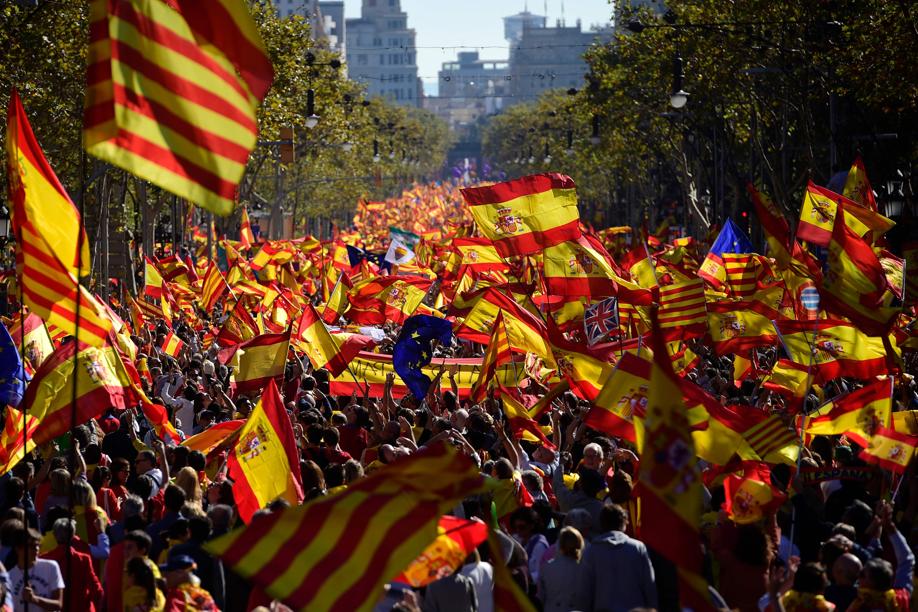
BARCELONA — About 300,000 Spaniards on Sunday took part in a demonstration Sunday to show they were against an independent state in Catalonia and for the central government’s takeover of the breakaway republic.
And many said they wanted to see the leaders of the attempted secession punished.
As the streets swelled with protesters waving Spanish flags, there were chants urging authorities to arrest Catalan regional president Carles Puigdemont and his top lieutenants.
‘‘To jail!’’ they shouted. Some held aloft posters showing Puigdemont behind bars.
Inés Arrimadas of the Citizens party in Catalonia told reporters before the march began that ‘‘the silent majority of Catalans are once again taking to the street to show that the majority of Catalans feel Catalan, Spanish, and European.’’
Arrimadas walked out of the Catalan regional Parliament on Friday as it cast the vote for independence.
Frustrated by a defiant but divided Catalan Parliament, the central government on Saturday began to assert control over Catalonia, firing the region’s president, ministers, diplomats, and police chiefs and transferring all authority to Madrid.
Since then, the secessionist leaders have been mostly absent from the public stage — not exactly in hiding, but close.
Puigdemont on Saturday issued a brief prerecorded call for citizens to mount ‘‘a democratic opposition’’ to the takeover. No one was exactly sure what he meant.
On Sunday the Belgian migration minister offered him political asylum — if Puigdemont needs it.
Two top leaders of the Catalan secessionist movement are already in jail, without bail, as prosecutors mull sedition charges.
The Spanish newspaper El Periódico reported that Spain’s interior ministry on Sunday ordered the Catalan regional police stations to take down their portraits of Puigdemont.
The next showdown is scheduled for Monday morning when bureaucrats return to work and the doors open to the Catalan government and Parliament.
Will Puigdemeont and his ministers return to work — or try to run a parallel government?
Oriol Junqueras, the Catalan vice president dismissed by the government of Spain’s prime minister, Mariano Rajoy, warned in a regional publication that in coming days the independence movement ‘‘will have to make difficult decisions that will not always be easy to understand.’’
After being awarded sweeping powers by the Spanish Senate last week, the central government, in the early-morning hours Saturday, published lists of more than 140 Catalan officials, alongside their advisers, who were being fired.
The Catalan Parliament was also dissolved by order of Spain, and new elections were scheduled for Dec. 21.
Reuters quoted Íñigo Méndez de Vigo, a government spokesman in Madrid, saying, ‘‘If Puigdemont takes part in these elections, he can exercise this democratic opposition.’’
Spain’s foreign minister, Alfonso Dastis, told the Associated Press that Catalonia’s deposed leader would be eligible to run in the regional election called by the central government on Dec. 21, provided he hasn’t been imprisoned by then.
Dastis said Puigdemont’s pro-independence party could ‘‘theoretically’’ put him up as a candidate, ‘‘if he is not put in jail at that time.’’ Puigdemont could face criminal charges for his role in the separatist movement.
Also Sunday, Spain’s interior minister reminded Catalonia’s regional police of their obligation to obey the Spanish Constitution and local laws amid an institutional showdown over secession.
Juan Ignacio Zoido wrote in an open letter to all police stationed in Catalonia, which include the National Police, the Civil Guard, and Catalonia’s regional police force. He wrote they must ‘‘obey orders, guarantee the rights of all, and fulfill the mandates of the Constitution’’ and Catalonia’s charter law.
On Sunday, the streets in Barcelona belonged to pro-unity, pro-Spain voices.
Javier Rodriguez, 55, a banker said, ‘‘This is a big day, a day for the real Spain.They told us we weren’t Spain. We are, today and always.’’
Asked what he thought of a declaration of a Catalan republic, he shook his head no. ‘‘This was a big fake. This republic is over, it is definitely over.’’
As he spoke helicopters circled over the demonstrators, each with the markings of a different force: the National Police, the Guardia Civil and regional Catalan police, d’Esquadra.

