


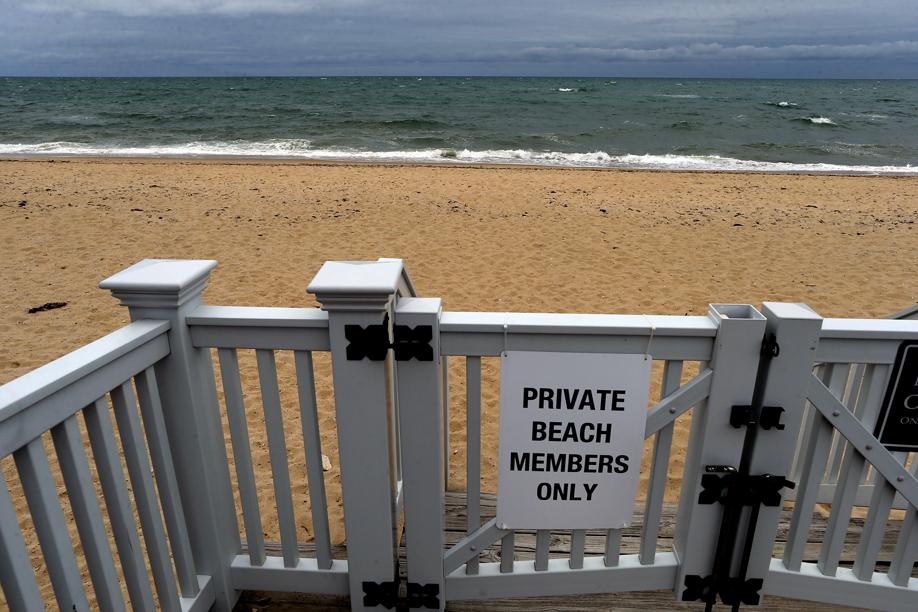
MASHPEE — With unparalleled views of Nantucket Sound, two lush golf courses, and a private beach, life should be good at New Seabury.
Hardly.
These days, instead of working on their handicap, members of the country club are gearing up for a legal battle with billionaire investor Carl Icahn, the owner of the 1,500-acre waterfront Cape Cod community. No, it’s not about whether you can wear jeans in the clubhouse, but whether Icahn is violating a 1998 bankruptcy court order that prohibits dramatic changes in membership terms.
But before we get too far, I know what you’re thinking. It can be hard to feel sorry for people with million-dollar second homes. Bruce Lehman, one of the ringleaders behind the insurgency, knows the optics aren’t greatbutargues one-percenters have rights, too.
“It’s the principle of it,’’ Lehman said, as he gave me a tour, driving past manicured lawns. “It’s the attitude of private equity.’’
The tit-for-tat began in March when the management of New Seabury Properties, a subsidiary of Icahn Enterprises, sent a letter to its approximately 780 members proposing to streamline the number of membership categories from 33 to 6. Some members got upset because their annual dues could go up as much as 30 percent, and some would lose privileges to a new fitness center and pool.
A group filed a motion in April to reopen the bankruptcy case, alleging that Icahn’s company had violated the original agreement. Members had until May 15 to decide what to do, but after petitioning the court for more time, a judge this week gave them until the end of the month.
Some members aren’t waiting for a court ruling. They’ve resigned, upset over management’s confrontational style. Others are scoping out Willowbend, another exclusive golf community in Mashpee.
Paul Kruzel, the general manager of the New Seabury Country Club, did not return calls for comment about the brewing controversy, but in court documents disputed the idea that members are being unfairly treated.
“The new membership categories do not seek to eliminate old memberships or ‘coerce’ members to switch to a new category, especially as members have the choice to stay in their existing categories, which is the default unless they select a new membership category,’’ Kruzel said in a statement filed in court.
Kruzel also said there is “no disparity in the dues increases,’’ even though costs will rise about 20 percent for those in preexisting categories. For all members, the average increase in dues will be less than $1,600, while some members may see a decrease. The higher fees, he explained, will help pay for a proposed $10 million in capital improvements that include a new fitness center and upgrades to the clubhouse.
Rather than a revolt, Kruzel painted a portrait of members embracing the new structure. Many members, he said, have expressed “no concern’’ and “advised the club they prefer the new membership categories.’’
Lehman, who ran and founded a Boston advertising agency, hardly calls this a case of a few disgruntled people.He said members have been asked to contribute $500 each for a legal fund, and about 300 have done so.
Susan O’Donnell, who owns a vacation home in the New Seabury development, figured she will pay more and get less under the new plan.
To retain her family’s sports membership — which gives access to the beach, gym, pool, and tennis amenities but not golf — will now cost $4,536, up 20 percent from the previous year’s annual dues. She would also not be able to use the new pool and fitness center being proposed.
If O’Donnell moved into a new category, her dues would be $3,950, but she would lose the ability to get back the bulk of her $25,000 initiation fee.
A member since 2009, O’Donnell decided to give up her sports membership this year. What the club management should have done, she believes, is to grandfather in currentmembers with their existing privilegesrather than penalize them for not joining the new groups.
“They have right to raise the dues. They have the right to consolidate,’’ said O’Donnell, a partner in a consulting firm who lives year-round in Southborough. “The old members who stay with the old membership become second-class citizens.’’
Talk to country club consultants — yes, you can make a living doing that — and they’ll tell you these disputes are inevitable at nonequity clubs, or those not owned by members. Most country clubs are member-owned, which allows them to control their fates.
New Seabury members pay initiation fees and annual dues, but are not owners, so Icahn ultimately can do whatever he wants. Friction often occurs when members want to run the club like a nonprofit, while the owner wants to make money. Icahn probably makes much of his money building homes in New Seabury, not running the country club.
“When you have an independent owner, you almost generally get into a ‘we-they’ situation,’’ said Bill McMahon, chairman of the McMahon Group, a St. Louis firm that works with 1,200 private clubs across the country. “What’s good for the developer might not be good for the members of the club.’’
New Seabury, one of the country’s first planned communities, started in the 1960s. It was billed as a Cape Cod development within reach of the middle class, and initiation fees were $500. Buy land, build a second home, golf on a course dubbed the “Pebble Beach of the East.’’ All just a 90-minute-drive south of Boston.
Icahn — a corporate raider-turned-activist investor known for shaking up companies from RJR Nabisco to eBay — took control of New Seabury in 1998 after the previous owner filed for Chapter 11 bankruptcy.
At the time, members were ecstatic. The New York titan vowed to turn the tired-looking development into a first-class resort community. He poured money into the place. He built a new country club. He planted rose bushes and sea grasses.
Today New Seabury is considered one of the nicest full-service resorts on the Cape — one that can appeal to golfers and beach lovers. The community consists of about 2,000 homes, ranging from $300,000 fixer-uppers to $5 million McMansions. Popponesset Island is also part of the development, where New England Patriots owner Bob Kraft and his family have a compound.
“It was a very good thing for New Seabury,’’ said Paul Grover, co-owner ofRobert Paul Properties,of Icahn’s ownership. “He turned things around.’’
That’s why some members are so taken aback by the abrupt changes to the membership contract.
“It’s out of character,’’ said Cass Costa, a homeowner who has been a member since 1970.
Dave Tacelli, the CEO of a Norwood semiconductor equipment company, joined the club a couple of years ago after buying a home in New Seabury. He has been asking acquaintances who know Icahn if this is how the famously hard-nosed businessman operates. The answer was no.
“He’s actually a very, very solid guy, and he thinks about his customers a lot,’’ Tacelli was told.
Which makes Tacelli think that Icahn must not know what’s going on.
“A guy like that, this is so far off his radar screen. If he knew the kind of treatment that was going on to his 700 members, this would not be allowed,’’ said Tacelli. “This has to be the minions that are underneath him . . . It can’t be him.’’
For now, we don’t know what Icahn knows. I’ve left several messages with his assistant in New York, and I’m still waiting for a call back.
Tacelli’s theory is that the billionaire is prepping New Seabury for a sale. He’s getting rid of liabilities and simplifying complicated contracts for a potential new owner.
“Follow the money,’’ said Tacelli. “Always follow the money.’’
Shirley Leung is a Globe columnist. She can be reached at shirley.leung@globe.com. Follow her on Twitter @leung.

