


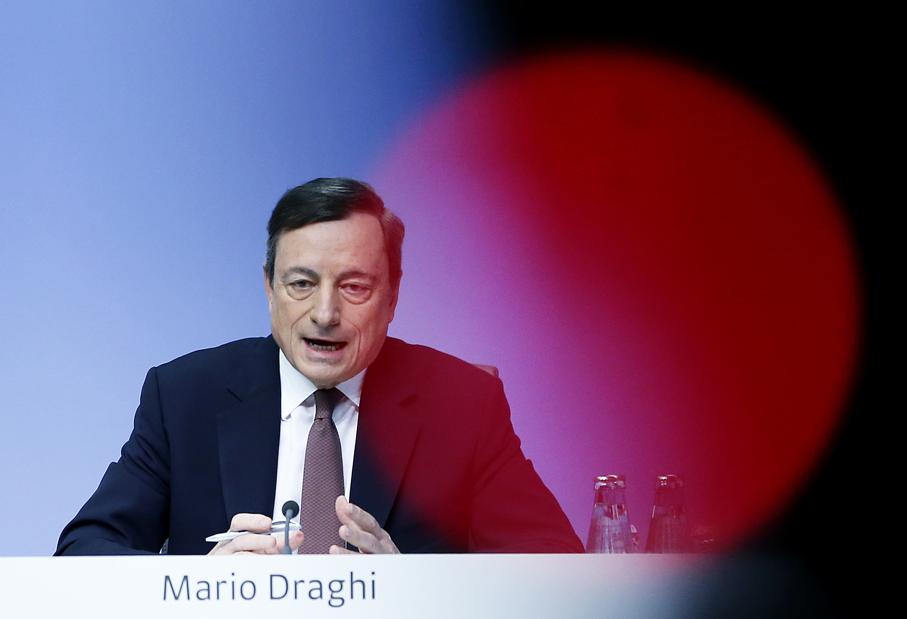
FRANKFURT — European Central Bank head Mario Draghi signaled the bank could trim back its stimulus efforts if the economy keeps strengthening, but said that any such move would be gradual and cautious.
Draghi said in a speech Tuesday at an ECB conference in Sintra, Portugal, that ‘‘a considerable degree’’ of stimulus support was still needed and ‘‘we need persistence in our monetary policy.’’
But he said the bank’s level of stimulus will be adjusted as the economy improves but would remain supportive of the economy, or ‘‘accommodative,’’ as Draghi put it.
The euro rose a sharp 0.9 percent against the US dollar to $1.1280 upon the remarks, a sign that foreign-exchange traders may have interpreted Draghi’s words as signaling a willingness to withdraw stimulus.
Central bank bond purchases and interest-rate cuts can weigh on a currency’s exchange rate; an end to the stimulus should mean a stronger euro.
Market observers are watching for signals about when the ECB will start reducing its 60 billion euros — about $67 billion — per month in bond purchases, a program that aims to increase inflation and growth.
The central bank has edged toward the exit in recent comments, saying that risks to the economy have lessened and that it could do even better than expected.
Draghi has not said when the purchases might be scaled back. They are slated to run at least through year’s end, and longer if needed. Many analysts think the bank might give a clear signal at its Sept. 7 meeting.
Marco Valli, chief eurozone economist at UniCredit Research, said the speech indicated that ‘‘the ECB seems on track for a tapering announcement in September.’’ Valli said in a research note that, absent unexpected trouble for the economy, bond purchases could be reduced to 40 billion euros a month in the first half of 2018 and to 20 billion euros in the second half, before ceasing at year’s end.
The stimulus withdrawal decision is being closely watched because it could have wide-ranging effects on investors, governments, and consumers. The bond purchases are designed to drive down long-term interest rates and raise inflation by sending newly printed money into the banking system and the economy. When they end, rates should rise, meaning higher costs for longer-term borrowers such as people with home mortgages. Savings accounts or other conservative holdings would be more attractive, relative to stocks.
The ECB is trying to raise inflation from the current 1.4 percent toward its goal of just under 2 percent, a level it considers most consistent with a healthy economy. Inflation has lagged even during 16 straight quarters of growth for the 19 countries that use the euro currency.
Draghi said that inflation was not picking up as fast as it typically does. That could be because wage and price decisions were still affected by the crisis and Great Recession. Because of the bout of low inflation that followed, people were still writing smaller increases into wage contracts. He said that such ‘‘backward-lookingness’’ would eventually give way to stronger inflation as the recovery continues. but it would take time.

