


Music Review
BOSTON SYMPHONY ORCHESTRA and TANGLEWOOD MUSIC CENTER ORCHESTRA
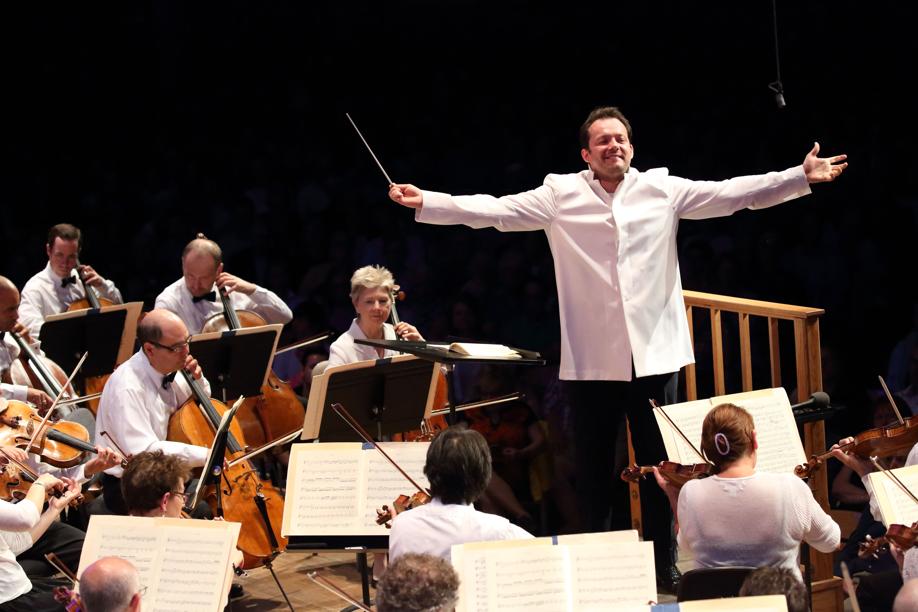
Andris Nelsons, conductor
At Tanglewood, Friday, Saturday, and Sunday
LENOX — It’s true that the basic operations of Tanglewood can function without an actively engaged music director — or even, as summers in recent memory have proven, without a music director at all. But there’s also no mistaking the quickening of interest and of tempo on these bucolic grounds when the orchestra’s own artistic leader is around campus and on the podium.
This weekend, making his first of two Tanglewood visits for the summer, Andris Nelsons reminded you once again of all of the above. The BSO gave two performances in prime form, and the Koussevitzky Music Shed seemed much fuller than usual. Then there was the added benefit of his presence for the students of the Tanglewood Music Center, who had the chance to work with Nelsons closely over the course of no less than five rehearsals last week. And evidence of the enthusiasm and excellence he is capable of sparking in these impressive younger players was everywhere apparent on Sunday afternoon as the TMC Orchestra performed an all-Brahms program designated as the yearly Leonard Bernstein Memorial Concert.
All of this said, Nelsons was still making a “visit’’ to Tanglewood rather than coming home to the summer residence of his own orchestra. Up until this point, his time in Tanglewood has been limited by his other standing commitments that predated his appointment at the BSO — most especially, his long-term relationship with the Bayreuth Festival in Germany. This equation, however, may be changing. Earlier this summer, Nelsons abruptly withdrew from a new “Parsifal’’ production in rehearsal. His official press statement indicated only that “the atmosphere at this year’s Bayreuth Festival did not develop in a mutually comfortable way for all parties.’’ (The German press, however, was more pointed in its speculation, laying the blame at the feet of Bayreuth music director Christian Thielemann.)
Whatever the case, with Nelsons’s future status at Bayreuth seemingly up in the air, one can’t help but wonder if he may soon have more time available to spend at Tanglewood. This would clearly be a boon for Tanglewood audiences, but not just for them. Ultimately, the place and its history is so ingrained in the orchestra’s DNA that a deeper Nelsons connection to the festival would mean a more substantive relationship to the institution as a whole.
It would mean that Nelsons would be able to build more overall during his tenure with the Boston Symphony, and obviously it would allow him to place his own mark on the Tanglewood Music Center in a way that occasional visits will not. And lastly, a change like this would seem to serve other aspects of his own stated goals. When Nelsons accepted a second podium with the Leipzig Gewandhaus Orchestra, he did so with a pledge to “consolidate’’ his other European commitments, for his own sanity and for the benefit of the institutions that have entrusted him with their leadership. This would seem a perfect opportunity to do just that.
The weekend of concerts opened Friday with piano soloist Jonathan Biss performing, with understated elegance, Mozart’s Piano Concerto No. 27. And the Mozart was followed by Mahler’s Ninth Symphony, a work that the orchestra has recently played on tour with Nelsons. Here he once again rendered the score’s enormous outer movements as organically paced and compelling statements, even if the Rondo-Burleske might have benefited from more sharply defined characterizations. Nelsons shaped the symphony’s moving final pages with utmost care, and a large Shed crowd actually held its applause long enough to permit a generous few seconds of pristine silence.
Saturday night’s program sensibly paired Beethoven’s Seventh Symphony with John Corigliano’s “Fantasia on an Ostinato,’’ which takes its inspiration (and quotes directly from) the Allegretto of the same symphony. Nelsons in the Beethoven conveyed the music’s irrepressible rhythmic imperative, its sense of a composer not only storming the heavens but directing them to dance. Between the two works, violinist Augustin Hadelich returned as soloist in the Sibelius Violin Concerto, a work that seemed particularly well-suited to his own interpretive strengths. His account on Saturday was tonally rich and electric, and he followed it with a musically generous encore: the Andante movement from Bach’s Second Sonata. After all the high-strung rhapsodizing of the Sibelius, this humble, wise music from Bach was just what the ear needed to hear.
And finally, on Sunday afternoon, it was the pianist Paul Lewis’s turn in the spotlight as soloist in Brahms’s Piano Concerto No. 1. Lewis’s account was distinguished by the pellucid, classical clarity he brought to this score, without sacrificing an ounce of the music’s excitement. After intermission, the TMC Orchestra played its heart out for Nelsons in a tonally generous, high-octane performance of Brahms’s Symphony No. 1. He clearly has a way of inspiring these young musicians. Let’s hope that in future summers, he has even more opportunities to do so.
BOSTON SYMPHONY ORCHESTRA and
TANGLEWOOD MUSIC CENTER ORCHESTRA
Andris Nelsons, conductor
At Tanglewood, Friday, Saturday, and Sunday
Jeremy Eichler can be reached at jeichler@globe.com.

