


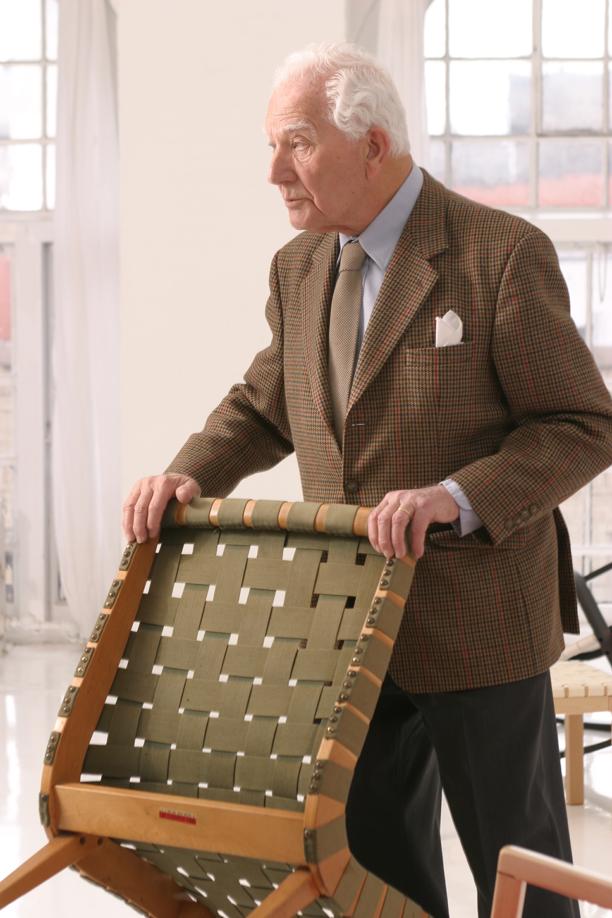
NEW YORK — Jens Risom, the Danish furniture maestro who helped bring midcentury modern design to the United States through his work with Knoll Studio, died Dec. 9 at his home in New Canaan, Conn. He was 100.
His death was confirmed by a friend, Mark Jespersen.
Defined by sharp Scandinavian lines and fused with the rustic aura of Shakerism and US arts and crafts, the armless, affordable chair that became Mr. Risom’s signature in 1942 was one of the first mass-produced modernist furniture pieces introduced in the United States and not Europe.
It both introduced Knoll as one of the world’s most enduring quality furniture brands and helped make great mass design palatable to US consumers, who continue to buy Mr. Risom’s chair 74 years later, in every possible color and fabric, through Knoll and Design Within Reach.
Today, the Museum of Modern Art, the Brooklyn Museum, and the Cooper Hewitt, Smithsonian Design Museum all have Risom selections in their permanent collections. Hundreds of high-end vintage dealers collect and sell Mr. Risom’s black leather benches and walnut magazine stands on the antiques website 1stdibs. A recent auction for six vintage wastepaper baskets by Mr. Risom netted $10,625 with Wright, the country’s leading modern design house.
“A lot of people think of modernism as cold and clinical or bold and colored, and Risom’s was neither,’’ Wright auctioneer Richard Wright said in an interview. “It’s quiet and warm.’’
Jens Risom was born in Copenhagen. His father, Sven, was a successful architect in the neo-Classical style, and his mother was a homemaker.
In the 1930s, Mr. Risom studied at the Royal Danish Academy of Fine Arts, now known as the Danish Design School, which was for Danish cabinetry makers something akin to matriculating at Harvard.
One of his teachers was Kaare Klint, father of Danish modernism. Mr. Risom’s classmate Hans Wegner went on to become perhaps the most renowned chair designer of the 20th century.
Shortly before Germany’s invasion of Denmark in 1940, Mr. Risom immigrated to the United States, took a job at a small textiles firm, and met Hans Knoll, a German immigrant whose parents worked in the furniture business.
“Without knowing it, he was looking for me and I was looking for him,’’ Mr. Risom told Wallpaper magazine in 2008. “He wanted to get into manufacturing quality furniture.’’
Materials were hard to come by during the war, so Mr. Risom designed a chair with simple wooden legs and for upholstery used nothing other than surplus parachute straps. The surprise was that Mr. Risom’s creation — one of 15 pieces he designed for Knoll’s debut collection, and perhaps too humble to ever be described as a masterpiece — was almost comfortable enough to sleep in.
But Mr. Risom would not be doing that — not then, at least.
Just as Knoll was taking off, he was drafted into the Army and shipped off to Europe, where he served with the Third Army as an interpreter under General George S. Patton after the Allied invasion at Normandy. In his spare time, he redecorated the platoon’s barracks.
Mr. Risom returned to New York after the war. There, Knoll was involved romantically and professionally with a furniture designer named Florence Schust, who held a view of modern design that was in direct opposition to Mr. Risom’s.
Where Mr. Risom was a Dane seduced by the allure of homey Americana, Schust — soon to be Knoll — was a Michigan-born disciple of Ludwig Mies van der Rohe, who had returned from a stint at the Architectural Association in London transfixed by the chilly austerity of the German Bauhaus movement.
Mr. Risom left Knoll in 1946 and began Jens Risom Design, which showcased his residential and office furniture in advertising campaigns by Richard Avedon that presaged the Madison Avenue aesthetic of the early 1960s.
If Mr. Risom was somewhat eclipsed by contemporaries like Wegner, that was partly because he “wasn’t a showy or verbal polemical designer,’’ said Juliet Kinchin, curator of modern design at the Museum of Modern Art.
Ultimately, however, the design world embraced his work again.
In his later years, Mr. Risom served two five-year terms as a trustee of the Rhode Island School of Design and was knighted in Denmark by Queen Margrethe II. An enduring partnership with upscale furniture dealer Ralph Rucci brought renewed attention to his work, as well.
Mr. Risom’s first wife, the former Iben Haderup, died in 1977. His second wife, Dr. Henny Panduro Madsen, died in 2015.
He leaves two daughters, Helen Risom Belluschi and Peggy Risom Bull; two sons, Thomas and Sven; a brother, Niels; 11 grandchildren; 10 great-grandchildren; and two stepchildren, Helle Jacobsen and Dr. Michael Madsen.
To Wendy Goodman, design editor of New York magazine , there was a certain logic to the way Mr. Risom went to the United States and helped remind people there about the beauty of its unfussy design history.
“Maybe it takes someone coming here to do that,’’ she said, “because he romanticized the freedom and the openness of America, and that’s what’s so wonderful about his furniture.’’

