


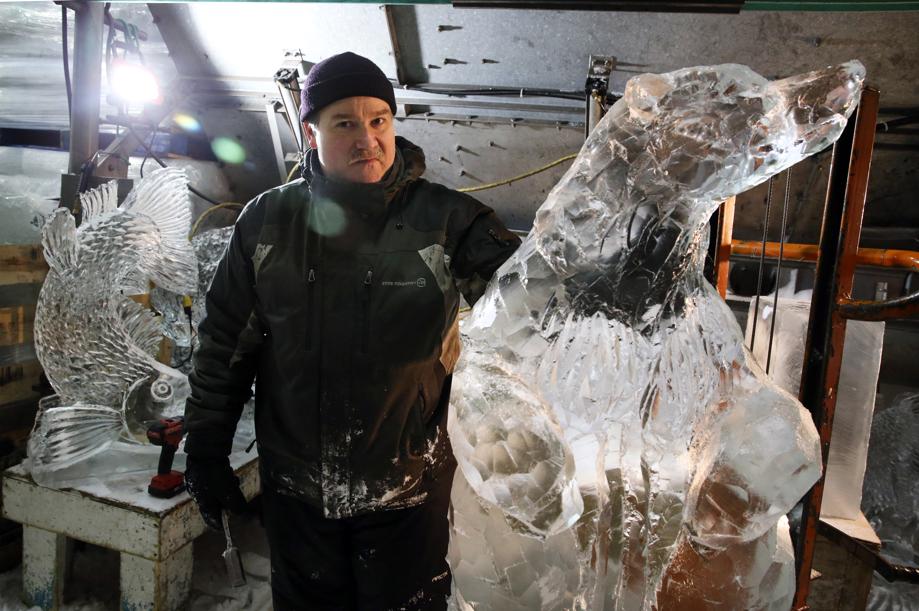
How easy is it to sculpt a likeness of Elvis out of ice? Or how about an elephant, a grand piano, or a life-sized hockey player?
For ice carver Eric Fontecchio of Brookline Ice Co., the challenge of turning a plain block of ice into a crystal statue is, well, a really cool process. He’s been sculpting ice for more than three decades and says working with ice is very exacting and technically demanding.
“Once ice is cut, chiseled, chipped, or scrapped away, an error isn’t easily fixed,’’ said Fontecchio, 52. But these days, thanks to years of practice, he can effortlessly turn a 300-pound block of ice into an intricate carving in an hour or less.
Fontecchio spoke with Globe correspondent Cindy Atoji Keene about his chilly pursuits.
“My work attire is a ski jacket, boots, and snow pants because I’m working inside a freezer that’s only 26 degrees. Recently I worked on figurines for a seafood expo, including polar bear, shells, and fish. And I just finished making a fairy with wings for a different client. I made her sitting on a mushroom because that’s much safer than having her stand on thin ice ankles.
“I begin with a bar of ice. If it’s a large piece, I’ll assemble several blocks together, making a flat seam and pouring water that acts as a glue. I scratch the image on with an ice pick or outline it with a marker, then use a chain saw to cut away everything except the initial layout. From there, I refine using gouges, veiners, routers, and grinders.
“There are certain tricks I’ve learned through experience; working with ice is a method and discipline. There are secrets to unleashing an image in ice. I keep my chisel razor sharp because I like to see the flat planes that combine to create, say, the curvature of a forehead. Seeing those marks makes a sculpture more interesting and gives the viewer a raw understanding of how the sculpture process occurred. All these surfaces, planes, and angles refract the light and make the sculpture more brilliant.
“A typical ice sculpture will last the length of a party, about four to six hours or so. As it goes through different stages of melt, it transforms and becomes more shiny and brilliant and takes on a totally different form. I’ve been doing ice sculptures for years now, and I learned from the school of hard knocks. There’s only one way to learn ice sculpting, and that’s by doing it. Fate had it that I was going to become an ice sculpture and artist.’’
Cindy Atoji Keene can be reached at cindy@cindyatoji.com.

