


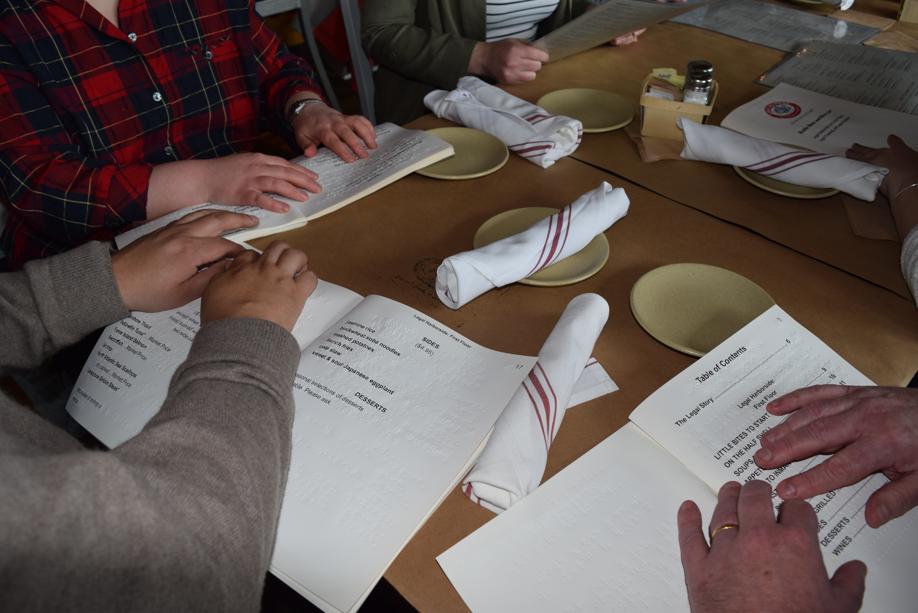
Everyone knows what to expect at a restaurant. There’s a menu. You scan the options. Read the details. Then order what you want. Whether fine dining or fast food, the process is pretty much the same. But if you’re blind or vision impaired, the experience can be very different from the start when you find no printed menu available.
The Boston-based nonprofit publisher National Braille Press works with restaurants locally and nationally to create Braille menus that improve accessibility for millions of people with visual impairment. The press was founded in 1927 to create Braille newspapers for blind readers and today promotes literacy for blind children and produces Braille materials for adults and children. Braille menus will be a topic of discussion at the organization’s annual meeting on June 21. Joseph Quintanilla, vice president of development who has been blind since birth, and Nicole Noble, director of sales who works with restaurant clients, discuss how Braille menus change the dining experience for people with visual impairment.
Q. How available are Braille menus?
Quintanilla: There aren’t a lot of restaurants that are doing it. Legal Sea Foods has been a leader nationally. They’ve been doing Braille menus for decades. Some of the national chains have done it, like Starbucks and Wendy’s, which we produce Braille menus for.
Q. Why are they found in so few places?
Quintanilla: Either the restaurant doesn’t necessarily think about it all the time, or sometimes even if they had it, the staff isn’t trained to know they have it. Ninety-nine percent of the restaurants I go to don’t have a Braille menu.
Q. Aren’t restaurants required to offer them under the Americans With Disabilities Act or other laws?
Quintanilla: ADA is always tough to interpret from a commercial standpoint. What they’ll often say is [the menu is] available on our website. But that’s not necessarily the most functional thing. Even the websites aren’t always all that accessible. Imagine you’re at a restaurant with 300 people in it and it’s very noisy. You’ve got some music in the background. You have your iPhone and ear buds in and you’re trying to scroll through the menu. You’re not able to hear it well or interact with [those] you’re having dinner with.
Noble: I’m sighted, and if I go to a restaurant I’m given a printed menu. I’m not told “You can go to our website.’’ I think it has a lot to do with fair standards.
Q. What are the other work-arounds when no menu is available?
Quintanilla: I’ll say somewhat jokingly to the server, “I hope you have a good reading voice.’’ Sometimes they’ll offer to read the menu, which is a good gesture. But they’ll often start off with “What are you interested in?’’ which is the most annoying question for me. I don’t know what I’m interested in because I don’t know what’s there. Or if you’re with a sighted friend, they’ll offer to read to you. It’s not the same experience as being able to [read for yourself and] say, “Hey Nicole, did you see this great beet salad?’’
Q. How do restaurants decide to produce Braille menus?
Noble: Some companies have departments devoted to accessibility, so they’re on top of the game. They’ll reach out to us looking for Braille menus. Locally, we have a large number of staff who are visually impaired. They frequent many restaurants, and those restaurants end up reaching out to us or us to them.
Q. What are the bad experiences like?
Quintanilla: Sometimes I’ve been at restaurants — and many of my friends who are blind have had the same experience — and someone will ask the sighted person that I’m with: “What is he having?’’ or “What would he like to order?’’ If I was given a Braille menu, I would be seen as another customer.
Q. Are there local restaurants that are especially good at serving blind customers?
Quintanilla: I eat out a lot. Generally, if they have a Braille menu there’s a level of attentiveness when a blind person comes in. I was at Legal Sea Foods on Saturday to meet some folks. The person who escorted me to the table offered me their elbow, which is what we refer to as sighted guide. As we were walking they said, “I will come back with your Braille menu.’’ There’s a group of friends who get together at least once or twice a year at Redbones BBQ to do a rib fest. They’re pretty good there.
Noble: Other local restaurants that we produce menus for are Union Oyster House, Oak Long Bar + Kitchen, and Johnny Rockets.
Quintanilla: And Life Alive. We have a growing vegan blind population. My colleagues who are vegetarian or vegans have gotten really excited since they’ve produced the Braille menus. A hamburger is pretty plain and simple. For a vegan menu, there’s a lot of nuance. Having access to all those details makes a difference in people feeling comfortable and maybe asking a question, exploring different tastes.
Interview was edited and condensed. Michael Floreak can be reached at michaelfloreak@gmail.com.

