


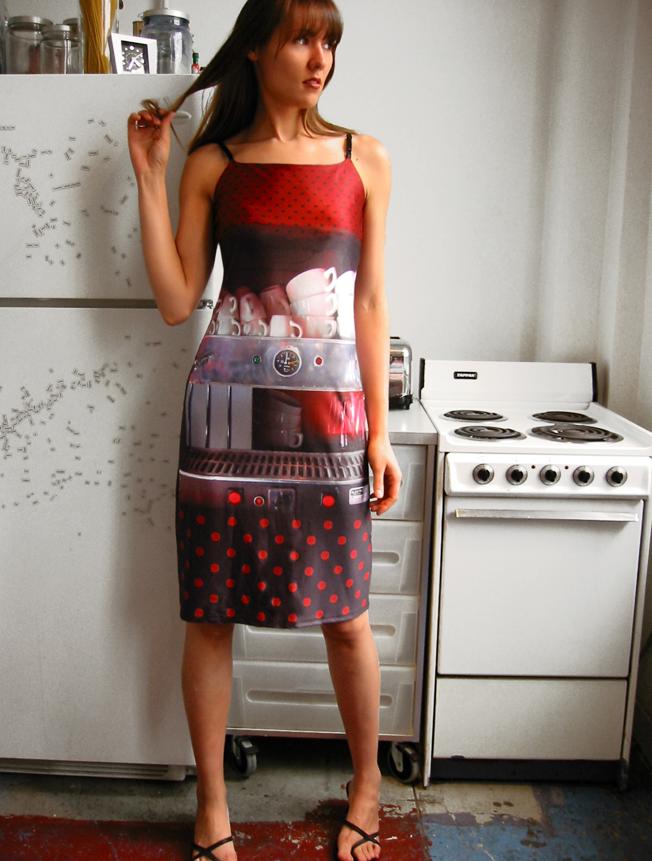
You can now wear your heart — or your cat, or your favorite sunset, or the view from the window of your apartment — on your sleeve. Or on all of you, in fact. Digital-print clothing has come into its own, as it becomes ever more affordable, customizable, and personal.
The technology has been around for decades, but one of the first breakthroughs came when two young designers launched the SUVA clothing line in 2001. Natalya Bagrova and Timothy Showalter used digital printing and their own travel photos to project their memories into cloth, designing sleeveless shifts emblazoned with Cambodian temples or Manhattan fire escapes.
By 2010, digital-print clothing was the star Alexander McQueen’s spring 2010 collection — a suite of clothes printed with glistening, photorealistic reptile scales — and ready-to-wear digital designs from Mary Katrantzou and Lana Dumitru followed, all covered in high-resolution images.
But as it turns out, image quality isn’t the only crucial innovation of digital printing. The real killer app is customization. The technology makes it as easy to print a single garment as it is to print 100, so it wasn’t long before print-on-demand clothing became more widely available. At high-end companies, like Print All Over Me or Boston’s CONSTRVCT, customers can upload their own images and receive their one-of-a-kind garment — slathered in print — through the mail. A recent app, Snapshirt, even works seamlessly with your smartphone camera.
Until recently, however, the cost has been steep. Print All Over Me offers a range of garments, running from $36 for a tank top to $238 for a long-sleeve dress. CONSTRVCT’s dresses run from $190 to $395.
But if you don’t mind sacrificing quality, newcomer Artscow — a mysterious online outfit based in China — will print you up a wardrobe on the cheap. The construction is a little flimsy, but the image quality is high, and a maxi dress is only $29. With products from sweatshirts to swimsuits, you could conceivably walk around wearing nothing but images you’ve selected — an externalized visual memory. In the future, our clothes could be a kind of textile telepathy, telling us so much more about each other than a T-shirt slogan could ever say.
S.I. Rosenbaum can be reached at si@arrr.net.

