


NORRISTOWN, Pa. — Bill Cosby paid nearly $3.4 million as part of a settlement with the woman he is now charged with sexually assaulting, a prosecutor said Monday as the comedian’s retrial got underway.
In his opening statement, District Attorney Kevin Steele described the 2006 civil settlement, suggesting that Cosby wouldn’t have paid out so much money if the accusations against him were false.
The amount Cosby paid to accuser Andrea Constand had been confidential, but a judge ruled that both sides could discuss it at the trial.
‘‘This case is about trust,’’ Steele told the jury. ‘‘This case is about betrayal and that betrayal leading to the sexual assault of a woman named Andrea Constand.’’
Cosby, 80, is charged with drugging and molesting Constand, a former employee of Temple University’s basketball program, at his suburban Philadelphia home in 2004. Constand says he gave her pills that made her woozy, then penetrated her with his fingers as she lay incapacitated, unable to tell him to stop.
‘‘She’s unconscious. She’s out of it,’’ Steele said. ‘‘She will describe how her body felt during this circumstance. She’s jolted during this. She feels herself being violated. . . . And she'll tell you she remembers waking up on this sofa with her clothes disheveled at 4 o'clock in the morning. This is hours after this starts.’’
The defense will deliver its opening statement Tuesday in a trial expected to last a month.
The start of Cosby’s retrial was delayed for several hours Monday as the judge reviewed a motion brought by Cosby’s lawyers to dismiss a juror.
Judge Steven T. O’Neill of the Montgomery County Court of Common Pleas met privately with both sides to discuss a defense contention that one juror had told another prospective juror last week that he thought Cosby was guilty.
After questioning the 12 jurors and six alternates behind closed doors, O'Neill ruled the juror could stay, saying all the jurors reaffirmed their pledge to remain fair and impartial.
The retrial is taking place 10 months after the first trial ended inconclusively with a deadlocked jury and a mistrial.
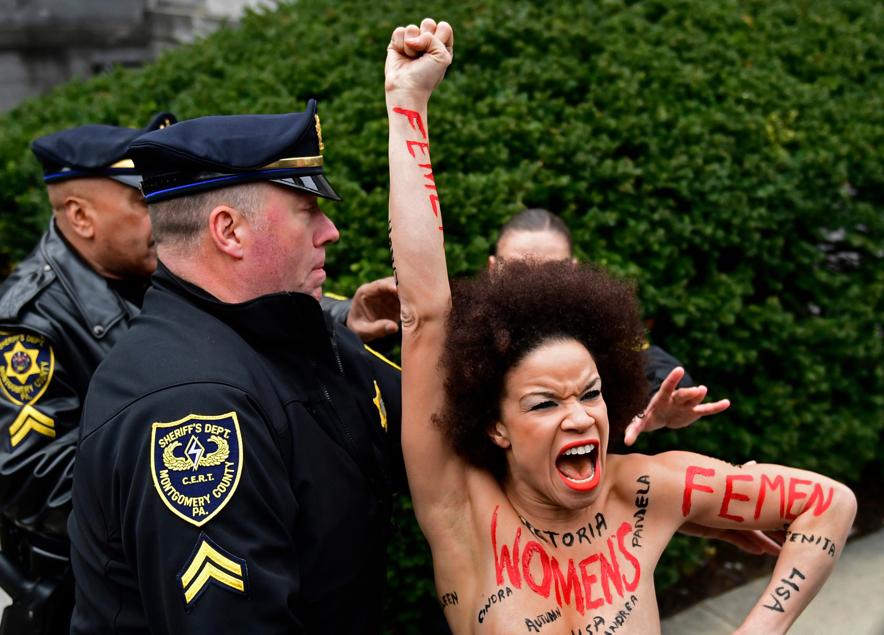
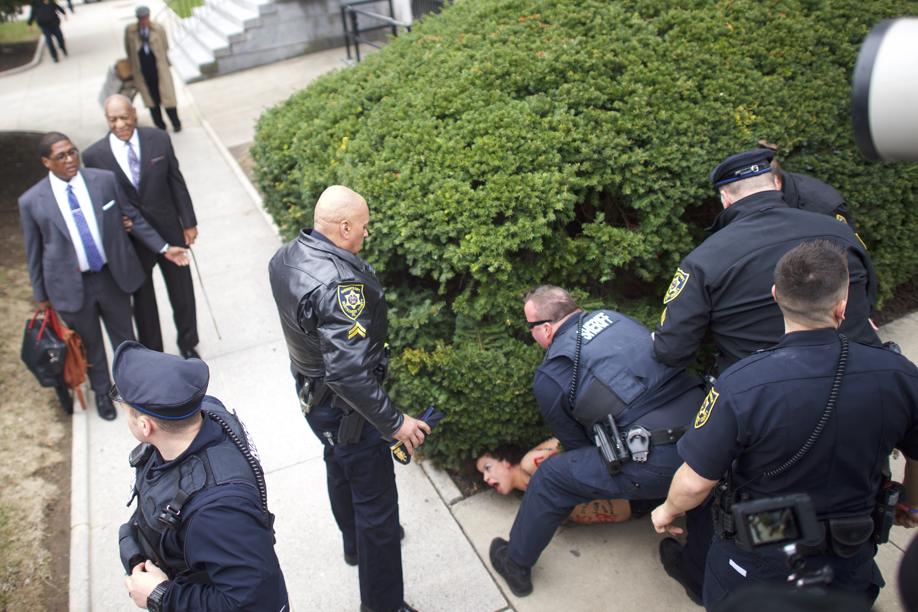
Cosby’s entry at the courthouse was briefly interrupted by the protest of a topless woman, later identified as Nicolle Rochelle, a former actress who had appeared several times on “The Cosby Show.’’
She jumped over a crowd barrier outside the courthouse and yelled “Women’s lives matter’’ before being wrestled to the ground by courthouse deputies about 10 yards in front of Cosby as he walked toward the building’s front doors.
Rochelle, 38, of Little Falls, N.J., had written on her torso the names of some of the many women who have accused Cosby of assault. Cosby, wearing a dark suit and using a cane, was guided toward a side entrance instead.
Rochelle is a member of European feminist group Femen, which is known for staging topless protests. In an interview after her arrest on disorderly conduct charges, Rochelle said she is a performing artist and activist who now lives in Paris.
“I wanted to get as close to him as possible without touching him,’’ she said. “It was a peaceful demonstration, but I wanted him to feel uncomfortable.’’
She had appeared on “The Cosby Show’’ in the early 1990s when she was 12 years old in a part as a friend of Cosby’s daughter on the show, Rudy. She said that nothing inappropriate had happened on the set with Cosby.
But now she said she wanted to express the anger of the other women and had chosen to do it topless so as to use her body as “a political tool.’’
About a dozen other protesters also demonstrated outside the courthouse, an indication of how Cosby’s profile has changed since he was one of America’s most beloved entertainers.
His is the first high-profile sexual assault trial of the MeToo era, and experts are watching to see what effect the of harassment and assault against prominent men may have on the trial and on jurors’ attitudes toward sexual assault.
Cosby, who has said the sex with Constand was consensual, was greeted by a handful of supporters, who shouted encouragement to him.
There are also expected to be crucial differences in how the retrial unfolds. At the first trial, for example, testimony was heard from just one other woman who said she was also drugged and assaulted by Cosby.
This time, O’Neill is allowing prosecutors to present the accounts of five additional women with similar accusations — a change that experts say will help bolster Constand’s credibility as just one in a line of women who say Cosby abused them.
One of the additional accusers prosecutors want to call is Janice Dickinson, the former supermodel, who said Cosby drugged and raped her in Lake Tahoe in 1982.
The four other witnesses were, at the time, aspiring actresses or models, and in one case a bartender, who say they were assaulted by the entertainer between 1982 and 1989 — all incidents he denies.
Another key difference is that the defense is being allowed to introduce testimony from a Temple University academic adviser who says that Constand once told her that she could make money by falsely claiming that she had been molested by a prominent person.
The testimony of the adviser, Marguerite Jackson, 56, was barred during the first trial when Constand testified that she did not know Jackson. But the defense has since brought forward two former Temple colleagues of Constand’s who said she knew Jackson.

