


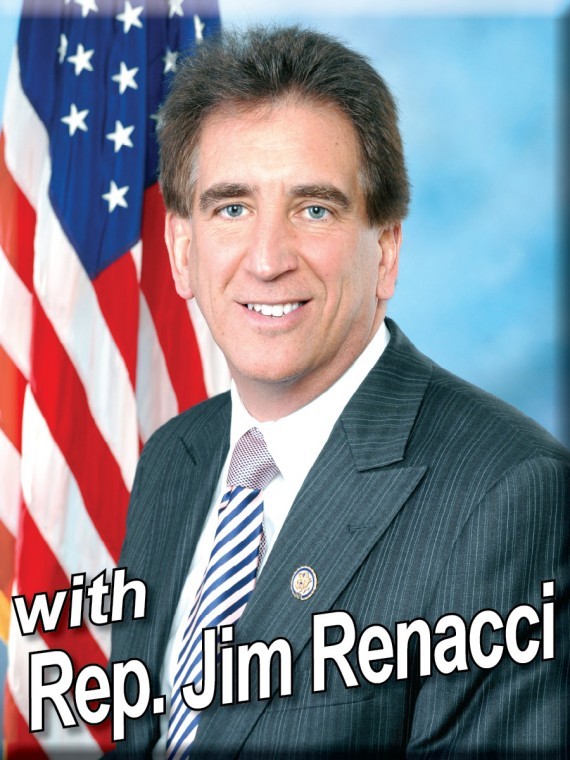
A moment with the Congressman
Workforce demands have evolved


Last week President Donald Trump visited the Operating Engineers Training Center in Richfield to discuss his vision for improving our nation’s infrastructure and strengthening the national workforce. The president’s proposal for rebuilding infrastructure in America includes critical reforms to improve access to high-quality education and workforce development programs.
Workforce development is something I have always been passionate about throughout my career. One of the most consistent concerns I continue to hear from local business leaders in northeast Ohio is not that there is a shortage of jobs available but that there is a shortage of qualified applicants. Every year, thousands of jobs across America go unfilled because businesses are unable to find employees who have the skills to succeed in the field.
Helping more Americans develop these skills is a pressing issue for our country. Having a good job and a good salary are the golden tickets to opportunity. We need to promote strategies such as expanding apprenticeships, work-based learning, and dual-enrollment opportunities to give more individuals a shot at the American dream.
In 2017, the House of Representatives made progress by passing of The Strengthening Career and Technical Education for the 21st Century Act and the Accelerating Individuals into the Workforce Act. If passed into law, these bills would provide millions of Americans with increased access to job training, education, and the skills-based learning opportunities that would allow them to pursue the high-skilled, high-wage jobs that are currently unfilled.
The demands of the American workforce have evolved dramatically in the last decade. The reality is that our laws are outdated and cannot conform to meet the needs of the 21st-century economy. An issue Trump hopes to resolve is the reformation of the Carl D. Perkins Career and Technical Education (CTE) program. The Carl D. Perkins Career and Technical Education Act, which passed in 1984, provided federal support to state and local career and technical education (CTE) programs. However, it was last reauthorized in 2006 and has not been updated for 11 years. The reformed program will allow more students access to skills-focused education.
Career and technical education play an invaluable role in meeting our workforce needs. CTE programs provide students an alternative to traditional four-year degree programs while preserving access to high-skill, high-wage jobs. In fact, half of all science, technology, engineering, and math (STEM) jobs require less than a bachelor's degree. More than 8 million Americans currently pursue a certificate, license or degree in CTE fields, and 27 percent of those with a certificate or license earn more than an individual with a bachelor's degree. That number rises to 31 percent for CTE students with an associate's degree.
It has long been said that education is the great equalizer in our country. Education in career or technical training, or a four-year degree, can provide for a better future. We owe it to the young people of today to make it possible to attain the American dream and I am proud to support the president’s efforts to invest in the American worker.
Workforce development is something I have always been passionate about throughout my career. One of the most consistent concerns I continue to hear from local business leaders in northeast Ohio is not that there is a shortage of jobs available but that there is a shortage of qualified applicants. Every year, thousands of jobs across America go unfilled because businesses are unable to find employees who have the skills to succeed in the field.
Helping more Americans develop these skills is a pressing issue for our country. Having a good job and a good salary are the golden tickets to opportunity. We need to promote strategies such as expanding apprenticeships, work-based learning, and dual-enrollment opportunities to give more individuals a shot at the American dream.
In 2017, the House of Representatives made progress by passing of The Strengthening Career and Technical Education for the 21st Century Act and the Accelerating Individuals into the Workforce Act. If passed into law, these bills would provide millions of Americans with increased access to job training, education, and the skills-based learning opportunities that would allow them to pursue the high-skilled, high-wage jobs that are currently unfilled.
The demands of the American workforce have evolved dramatically in the last decade. The reality is that our laws are outdated and cannot conform to meet the needs of the 21st-century economy. An issue Trump hopes to resolve is the reformation of the Carl D. Perkins Career and Technical Education (CTE) program. The Carl D. Perkins Career and Technical Education Act, which passed in 1984, provided federal support to state and local career and technical education (CTE) programs. However, it was last reauthorized in 2006 and has not been updated for 11 years. The reformed program will allow more students access to skills-focused education.
Career and technical education play an invaluable role in meeting our workforce needs. CTE programs provide students an alternative to traditional four-year degree programs while preserving access to high-skill, high-wage jobs. In fact, half of all science, technology, engineering, and math (STEM) jobs require less than a bachelor's degree. More than 8 million Americans currently pursue a certificate, license or degree in CTE fields, and 27 percent of those with a certificate or license earn more than an individual with a bachelor's degree. That number rises to 31 percent for CTE students with an associate's degree.
It has long been said that education is the great equalizer in our country. Education in career or technical training, or a four-year degree, can provide for a better future. We owe it to the young people of today to make it possible to attain the American dream and I am proud to support the president’s efforts to invest in the American worker.

