


LONDON — In Parliament, lawmakers are mired in gridlock over Britain’s departure from the European Union, with no clear path forward. In Washington, President Trump stormed out of a meeting with congressional leaders who oppose his border wall, hardening a standoff that has shut down much of the government for longer than ever before.
Two governments paralyzed. Two populist projects stalled. Two venerable democracies in crisis.
Rarely have British and US politics seemed quite so synchronized as they do in the chilly dawn of 2019, three years after the victories of Brexit and Trump upended the two nations’ political establishments. The countries seem subject to a single ideological weather system — one that pits pro-globalization elites against a left-behind hinterland.
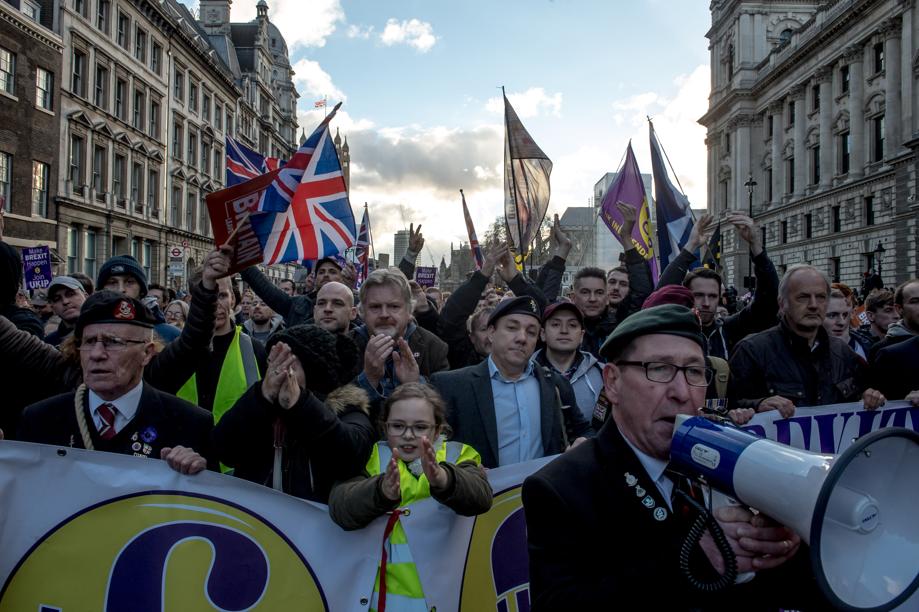
The similarities abound: Brexiteers love to compare their cause to the United States’ war for independence. At a recent right-wing rally, one man marched with a scale model of the Liberty Bell. Trump has exuberantly backed Brexit, while his friend, the Brexit godfather Nigel Farage, appears on Fox News, invoking Europe’s migrant crisis as a reason to back Trump’s wall.
“It’s stunning how parallel this is,’’ said Steve Bannon, who was an architect of Trump’s immigration policy as his former chief strategist and is an ally of Farage. “If you’re going to challenge the system, the system is going to fight back.’’
Bannon likened the possibility that Trump will declare a state of national emergency to build his wall over the objections of Congress to the once inconceivable but now real possibility that Britain will withdraw from the European Union in March without reaching a deal with Brussels — a hard Brexit.
“Trump is getting ready for his own no-deal, hard-out,’’ Bannon said, even as Republicans and Trump’s aides and family are urging him not to take such a step.
The trans-Atlantic dysfunction has far-reaching ramifications, given the role the United States and Britain, pillars of the NATO alliance, play in counterterrorism operations, intelligence sharing, sanctions enforcement, and dealing with conflict zones, including Syria.
With both countries also turning away from multilateral trade pacts, China has the opportunity to step in and play an even bigger role in the global economy. And Russia has seen an opening to expand its influence in Europe, where rising nationalism has threatened to fracture the European Union.
Trump and the Brexiteers have ridden a nationalist tide in their countries as well, using a potent anti-immigration message to appeal to voters who yearn for a simpler, more traditional society that no longer exists.
In Britain, immigration has provided an electric current to conservative politics since at least 1968, when lawmaker Enoch Powell delivered a seminal speech calling for immigrants to be repatriated. Quoting a Greek prophecy of “the river Tiber foaming with much blood,’’ Powell’s speech is credited with propelling the Conservative Party to victory in the general election of 1970, though it also turned Powell into a political pariah.
Fear of immigration spiked during the past two decades as Britain was hit with a series of terrorist attacks by Islamist militants and watched as migrants from Syria, Libya, and other war-torn countries flooded across Europe.
In the United States, where the right was once preoccupied by social issues such as abortion and same-sex marriage, immigration surged as an issue because of the changes wrought by globalization. Manufacturing jobs moved overseas, where labor was cheaper, while immigrants took both unskilled and high-tech jobs previously held by Americans.
By 2008, the financial crisis had wiped out millions of jobs, keeping people out of work for years and deepening the sense of grievance among many Trump supporters that immigrants were working for less and robbing them of their livelihoods.
Local politicians in California and elsewhere shot to stardom by introducing anti-immigrant ordinances. The Tea Party movement emerged, with core issues similar to those of Farage’s pro-Brexit UK Independence Party.
“The culture war has been replaced by a border war,’’ said Michael Lind, a visiting professor at the Lyndon B. Johnson School of Public Affairs at the University of Texas. The residents of rural postindustrial areas came to view globalism sourly, he said, as an urgent problem.
“The people in those areas just said: ‘OK, we’re not giving them any more time, the people in London and D.C., your time is up. We’re not going to wait a few more years for a recovery,’’’ said Lind, author of “Land of Promise: An Economic History of the United States.’’ “They decided: ‘There’s a limited pie. This pie is not growing.’’’
If the United States and Britain are both vulnerable to gridlock, that is partly for historic reasons. As two of the world’s oldest democracies, they spring from the same, centuries-old model: the electoral system known as first-past-the post or winner-take-all. Democracies that developed later introduced proportional representation, which allows for smaller parties to enter Parliament.
Winner-take-all, by contrast, tends to increase polarization between two large parties and exaggerate geographical divides, setting up stark conflict between sections of society.
And if Britain traditionally had a “strong, stable, efficient central state’’ that wielded control over policy making, this has been changing, as Parliament reasserts its power to block the government’s agenda — much as a House of Representatives controlled by the Democrats could thwart Trump.
“In my lifetime, Britain has never been in a more fragile state,’’ said Matthew Goodwin, an author of “National Populism: The Revolt Against Liberal Democracy.’’ “British politics is in an almost nonstop state of crisis. There are very high levels of polarization.’’

