


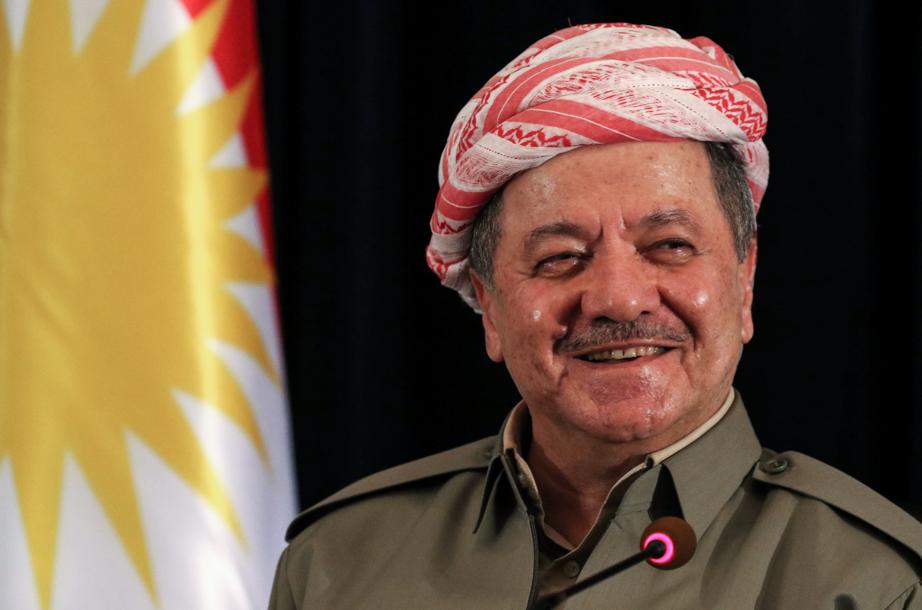
BAGHDAD — The longtime president of the Iraqi region of Kurdistan intends to resign, a month after he led a widely criticized referendum on independence that triggered a military response by the Iraqi government.
Masoud Barzani, whose father had been the face of the Kurdish minority’s struggle in Iraq, had promised that the vote would be a vital step in a century-long fight for self-rule.
Instead, it unraveled many of the gains the Kurds had made in carving out a semiautonomous region in northern Iraq after decades of war.
Clashes raged in front of Irbil’s Parliament Sunday after Barzani announced his plans, the Associated Press reported. Dozens of protesters attacked the building, members of Parliament, and journalists as Barzani addressed the region in his first televised speech since the referendum.
He blamed the central government in Baghdad for the regional crisis that followed the independence vote. ‘‘They used the referendum as an excuse. Their bad intentions were very clear from a long time ago,’’ he said.
‘‘Without the peshmerga the Iraqi army would never have been able to liberate the city of Mosul,’’ he continued, referring to Iraqi Kurdish fighters. ‘‘We thought that the international community would reward the peshmerga and the people of Kurdistan in return.’’
It was not clear whether Barzani intends to leave public life or whether his resignation would simply curtail his powers and redistribute authority to the legislature and the prime minister of the Kurdish Regional Government.
A senior Barzani aide said on Twitter that the president would not seek an extension of his mandate past Wednesday. Nov. 1 was the date of a planned election for president and Parliament that has now been postponed indefinitely.
Barzani, president of KRG since 2005, has continued to serve in the role despite his term expiring in 2013. He engineered several extensions through Parliament, roiling his opposition amid a security and financial crisis sparked by the rise of the Islamic State militant group in 2014 and the collapse of global oil prices.
Several of his Kurdish political opponents and Iraq’s central government accused Barzani of staging the referendum to shore up his shaky legal hold on the presidency. His supporters consider him the only credible candidate to lead the Kurds in a long-deferred quest for self-rule.
The aide, Hemin Hawrami, said Barzani wrote to Parliament that he will continue to serve Kurds as a member of the peshmerga, the armed forces of the Kurdish region.
Mustafa Barzani, Masoud’s father, led the forces in multiple uprisings against Iraqi rule dating to the 1940s and held the largely ceremonial position of commander until his death in 1979. Barzani and his family had been the primary architects of a referendum held last month on independence from Iraq. His son is the head of the KRG security council, and his nephew is prime minister.
Voters overwhelmingly approved of the move, but Barzani has been repeatedly warned by Iraq’s central government, the United States, and regional powers like Iran and Turkey that its results would not be recognized.
Of particular concern was the provocative decision to hold the referendum in areas historically disputed between Baghdad and the Kurds, including Kirkuk, an oil-producing province that Kurdish peshmerga forces seized during a chaotic withdrawal of Iraqi forces in the face of an Islamic State onslaught.
Immediately after the Sept. 25 referendum, Iraqi Prime Minister Haider al-Abadi ordered all border crossings, airports, and oil facilities in the Kurdish region turned over to federal control.
Earlier this month, Abadi ordered Iraqi forces into Kirkuk and other disputed areas. The show of force resulted in sporadic clashes that have since ceased as Iraqi and Kurdish commanders continued to negotiate Sunday over who would control border crossings with Turkey and Syria.
The United States did not initially oppose Abadi’s military move, saying it supported Iraq’s bid to impose federal control. It has since urged Baghdad and Kurdish authorities to set aside hostilities and resume talks on revenue-sharing and borders.
Despite warnings from Baghdad, the United States, Turkey, Iran, the United Nations and others, the independence vote was held Sept. 25 in the three provinces of the autonomous Kurdish zone as well as in disputed territories claimed by Baghdad, but at the time held by Kurdish forces.
The referendum proved to be extraordinarily costly. The region lost nearly half of the territory that had been comfortably under Kurdish control for years, including Kirkuk.
The region’s airspace was closed to international commercial flights, Turkey threatened the use of military force, and Iran and Turkey threatened to close border crossings vital to the land-locked region.
Iraq’s Kurdish region participated in the drafting of the country’s constitution after the overthrow of Saddam Hussein, but relations between Baghdad and Irbil deteriorated in 2014 under then-Prime Minister Nouri al-Maliki.
Maliki froze payments to the region after Irbil began unilaterally exporting oil through Turkey, a move that began to cripple the region economically. Kurdish leaders said they did so because Maliki had long sent the region a smaller fraction of the country’s oil profits than they were entitled to.

