


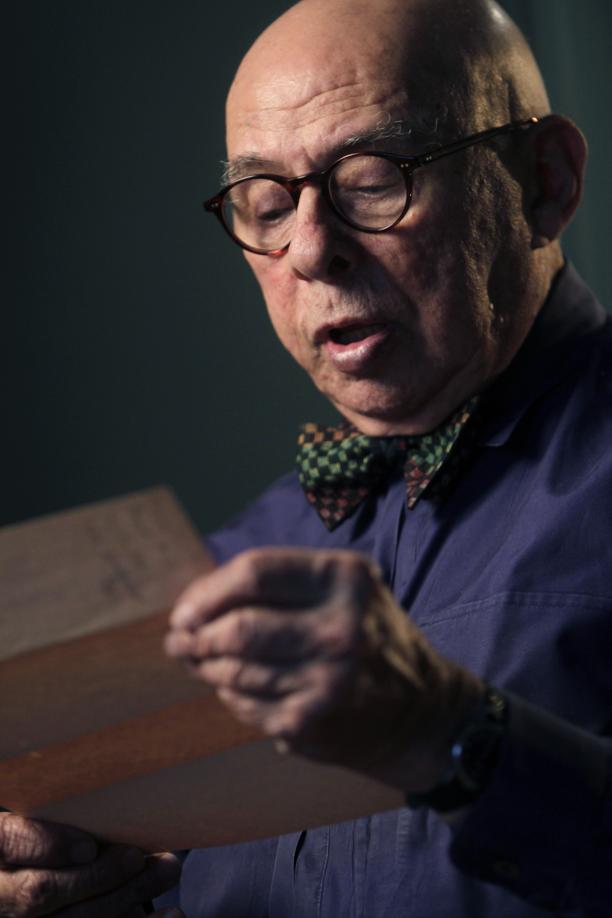
NEW YORK — When the MPs came for him in 1944, Melvin Dwork was in class, a 22-year-old gay Navy enlisted man in officer candidate school in Charleston, S.C. His companion, under arrest in New Orleans, had given him away. Jailed, found “deviant’’ by psychiatrists, he was discharged in World War II as “undesirable.’’
The word stuck in his craw after the war, an insult that never went away. As years passed, Mr. Dwork became a successful interior designer in New York City, and he and a prominent choreographer were companions for many years. He eventually forgave the man who betrayed him, but not the Navy.
In 2011, after years of trying to remove the blot on his record, Mr. Dwork, supported by advocates for gay and lesbian military personnel and veterans, won his point. The Navy officially changed his discharge to honorable.
“It meant an awful lot to me because I know I never did anything disgraceful or dishonest,’’ Mr. Dwork said in a 2014 interview for this obituary, in which he spoke of painful military policies and glacially slow changes toward gay and lesbian service members.
Mr. Dwork, who became a hero to gay people for his persistence in fighting the dishonorable discharge, died Tuesday in Manhattan, Alan Salz, the executor of his estate, said. He was 94.
Mr. Dwork was believed to be the first veteran of World War II to have an “undesirable’’ discharge for being gay expunged, although his case may have opened the floodgates for appeals in hundreds of similar cases. His was resolved shortly before the military ended its 18-year-old “don’t ask, don’t tell’’ policy, which barred openly gay people from service but prohibited discrimination against those not open about their sexuality.
While gay men and lesbians were explicitly barred by the military during World War II, many were quietly admitted to serve, especially in the war’s early stages to meet enlistment quotas, with a tacit understanding that they would be discreet. But later in the war purges rose, and Mr. Dwork and his companion were caught in them.
Both men were inducted in 1942 and, in 1943, they joined the Navy hospital corps, which was known to be more tolerant of gays. Mr. Dwork worked at the Naval Hospital at Parris Island, S.C. His partner, whom Mr. Dwork would never publicly identify, went to New Orleans. They exchanged love letters and phone calls, and once had a discreet rendezvous.
With excellent work ratings, Mr. Dwork applied for officer candidate school and, in 1944, was accepted for classes at the Medical University of South Carolina in Charleston. Gay friends warned him and his companion to forgo exchanging letters because of the dangers of exposure in campaigns against gays.
“We stopped writing, but it was too late,’’ Mr. Dwork said. At the time of his arrest, he believed that intercepted letters had given them away. He said it was not until many years later that he learned that his partner had been arrested, and had identified Mr. Dwork under the pressure of prolonged interrogations.
After his discharge, Mr. Dwork returned to New York. He studied at the Parsons School of Design, worked for antiques dealers, and from 1956 to 1959 was a partner in Altman-Dwork, a decorating and antiques concern. He assisted the designer Yale R. Burge in the 1960s and was a design partner of James Maguire’s in the early 1970s. He then worked independently for many clients, including RCA chairman Robert W. Sarnoff and film director Milos Forman.
His work was featured in The New York Times, House & Garden, Town & Country, and Architectural Digest. In 1993, he was inducted into the Interior Design Hall of Fame.
Mr. Dwork said that he and John Butler, a choreographer and former dancer with the Martha Graham Dance Company, were companions and friends from 1961 until Butler’s death in 1993.
After failing on his own to overturn the Navy’s “undesirable’’ discharge, Mr. Dwork got help from the Servicemembers Legal Defense Network, founded in 1993 to fight discrimination against gay and lesbian military personnel affected by the “don’t ask, don’t tell’’ policy. It interceded on his behalf.
On Aug. 17, 2011, the Board for Correction of Naval Records in Arlington, Va., changed Mr. Dwork’s discharge to honorable.
A record of the proceedings, obtained by the Associated Press, said the Navy had undergone a “radical departure’’ from its wartime ban on gays. It noted Mr. Dwork’s “exemplary period of active duty’’ and said it was acting “in the interests of justice.’’

