



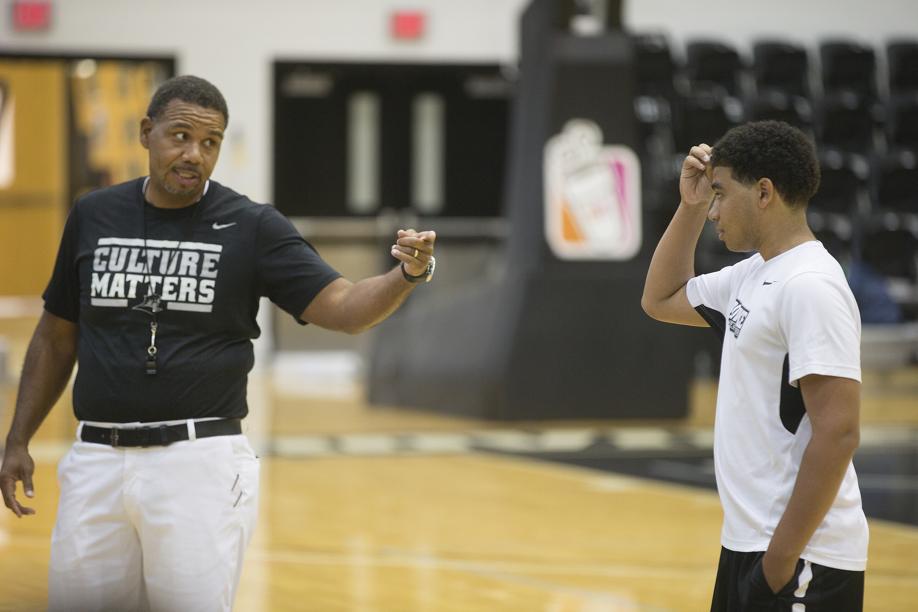
PROVIDENCE — Providence College basketball coach Ed Cooley has some advice for 110 fathers and sons gathered at an overnight camp.
“Let your kid see you be young again,’’ he says.
It’s a week before Father’s Day and although this looks like a basketball camp, with a half-dozen Friar players present, it’s not just that.
“It’s not about basketball,’’ insists Cooley, who runs the event. “It’s about how we connect. How best to be in the moment with your kid.’’
The fact that Cooley is leading a father-son camp is extraordinary in that he didn’t know his own father until he was 12 years old.
He grew up poor in South Providence, with eight brothers and sisters. His parents never married. He ate corn flakes with water because there was no money for milk and he survived on mayonnaise sandwiches and government commodities. He slept on a mattress that had springs sticking through.
As a pre-teen, Cooley played baseball with a neighborhood friend, Eddie Searight, who invited him home. Searight’s parents had hearts of gold and took him in. Cooley also worked at a local community center. He figured out a way to survive.
Cooley was a two-time Rhode Island Player of the Year at Providence’s Central High School. He played basketball at Stonehill College, then landed a job as an assistant at Boston College. He had five successful seasons as head coach at Fairfield, which led to the job at his hometown school in 2011. He has led the Friars to one Big East title and three consecutive NCAA Tournaments.
At the father-son camp, Cooley wears a T-shirt that says “Culture Matters.’’ At one point, he gathers the fathers and retreats to the cushy locker room for a truth-telling session. His personal playbook is tossed wide open. He tells them he speaks with a psychiatrist to deal with life’s pressures, struggles with weight even though he lost 161 pounds through surgery, and was worried this time last year about his son’s poor grades.
“Sometimes we’re afraid to ask for help because we’re too macho,’’ says Cooley. “We don’t want people to know we’re weak. We are. Accept it.’’
He also tells them he is jealous of them.
“I wish I could have gone to a father-son camp with my biological dad,’’ he says. “I see you guys smiling and hugging and engaging with your son. I didn’t have that opportunity. So thank you, fathers or guardians, for doing that.’’
‘All in the same boat’
Cooley tells the fathers that just being around isn’t enough.
“Sometimes you are present, but you’re absent,’’ he says. “All of our basketball activities are about communication. How do you communicate? Do you have great energy when you talk? Energy in your voice? Energy in your eyes? Great body language?
“If you can consistently [communicate], you’ll find your kids modeling your behavior.’’
The coach greets the campers as if he is the concierge at the Four Seasons, making sure everybody is comfortable.
“Tell me your name, son,’’ he says to a new arrival wearing a “Providence Friars’’ shirt.
“Alex.’’
“And yours?’’
“Brian.’’
“I’m going to remember your name before tomorrow morning,’’ Cooley promises them. “Every time you see me, just yell out your name. All right? Hey, I love the Friar gear, baby. I’m feeling it.’’
An hour later, he correctly recites almost every camper’s name.
In his private time with the fathers, Cooley speaks of his relationship with his own son, Isaiah.
“When I first came here, I felt like I was away from my son a ton because of my job,’’ he says. “I said, ‘Damn, I just want to connect with him.’?’’
So he asked his son about his feelings.
“What he told me blew me away,’’ says Cooley. “He says, ‘I’m used to it.’ Oh, that hurt. He said, ‘Sometimes I can’t sleep at night because I think you’re coming home.’ My son and daughter would wait up for me.’’
He said that made him change.
“That sparked me to do this and share these things,’’ he says. “We’re all in the same boat, guys.’’
Then he issued a challenge.
“Share some intimate thing with your kid while you are here,’’ he tells the fathers. “It might be something they’re not ready for, but they’ll remember it somewhere down the line.’’
The campers are aged 7 to 14.
“Right now, they are a pain in the ass,’’ Cooley says to the fathers.
Everybody nods and laughs.
“Let’s have fun,’’ says Cooley. “First thing, passing drills, shooting drills. If you miss, who cares?’’
The drills are designed to make fathers and sons over-communicate.
“When you’re over-communicating, you tend to get frustrated because you’ve repeated yourself,’’ says Cooley. “We always have to tell our kids 8-10 times to shut the lights out, 8-10 times to do your homework. Over-communicate without being upset.’’
After the drills and contest giveaways, there is pizza in the gym, and the NBA Finals are on the big screen. Then the fathers and sons drift off to the dorms and the not-so-comfy bunk beds.
Things can change
Bruce Ciummo was a senior account executive for a digital copier company four years ago when Cooley changed his life.
“I asked my boss if I could leave early to take my son to the camp,’’ he says. “She yelled at me, she screamed at me. She said, ‘You don’t care about your job.’ Coach Cooley talked to me. He said, ‘You don’t want to work for anyone who wants to keep you away from your baby.’?’’
Ciummo resigned, got his master’s degree at Providence, and took a job at Johnson & Wales University in academic technology. Now, he and his son come back every year.
“He actually changed my life and put me on the right track,’’ says Ciummo.
Cooley says things change quickly with children.
“Don’t forget, we were in their shoes,’’ he says.
Cooley’s son went away to school last year and improved his grade average from a 1.8 to a 3.2.
“I told him, ‘Wow. I am very, very proud of you,’?’’ says Cooley.
Isaiah, who is transferring to Providence College in the fall, says his father is his best friend.
“My friends said, ‘Damn, you talk to your dad all the time,’?’’ says Isaiah. “I said, ‘Yeah, that’s my guy.’
“The main thing is he’s real big on character. Be true to yourself and always do the right thing. In the end, every parent is teaching the same lesson. The lesson of life.’’
Fathers and sons were given pen and paper to write each other a letter, to be opened whenever they deemed appropriate.
P.J. Fernandes, a burly state trooper from Bridgewater, tears up when he talks about the thank you letter his son, Peyton, now 12, wrote to him one year.
“I was very surprised,’’ says Fernandes. “He wrote some stuff, and it was like, ‘Wow, my kid really gets it. He cherishes this.’?’’
Fernandes went to Stonehill with Cooley.
“Ed came from nothing,’’ he says. “One day, my father came to the college and slipped him a $20. He never forgot it.’’
Cooley now makes $1.6 million a year, according to USA Today.
“Hasn’t changed a bit,’’ says Fernandes.
Stephen Sylvia, an elementary school principal in Quincy who also went to Stonehill with Cooley, said attending the camp with his 8-year-old son Cameron is a no-brainer.
“When can you spend 24 straight hours with your kid and just play?’’ he says. “You just want to be a better dad, and listening to Coach Cooley makes you reflect on your own approach to being a dad. If you translate that to your own life, it pays off.’’
A message of gratitude
At the end of the camp, everyone is happy and exhausted. The campers have bonded quicker than Krazy Glue. The old guys have shown their kids they still have game.
The coach delivers his final message to the sons. He tells them to say thank you to their fathers and mothers till they are “blue in the face.’’
“Most of you are extremely fortunate to have your dad or somebody who is raising you right next to you,’’ he says. “Don’t be afraid to give them a hug. Kiss your dad; it means something if you physically give us a hug or kiss. Don’t ever think it doesn’t.’’
Cooley signs every autograph, poses for photos, and is the last to leave.
With Father’s Day coming up, he is asked why he forgave his father.
“Without him, I wouldn’t be here,’’ he says.
“Any time you dwell on negativity, that is the state you’ll stay in.
“I appreciate my father. Do I wish he’d been there? Sure, but he wasn’t, so what are you going to do? You can’t change it.
“All you can change is your attitude and your approach. So if there’s anything on Father’s Day to remember, it’s not what your dads didn’t do. It’s what they did do.’’
Stan Grossfeld can be reached at grossfeld@globe.com.

