


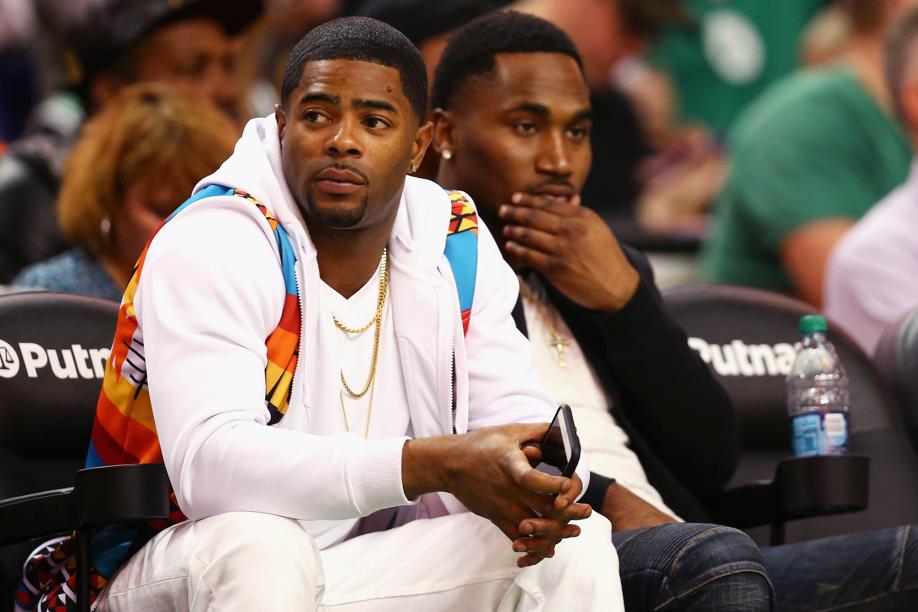
Malcolm Butler wasn’t protesting his pay grade when he missed a Patriots organized team activity (OTA) earlier this month. He wasn’t staging a sit-out in hopes of getting a higher payout than the $600,000 he is due this season. Butler said Tuesday that his unexplained absence was a big misunderstanding, citing “family issues, something like that’’ as the reason.
The Patriots’ Cinderella cornerback could be setting the record straight or he could be as adept at backpedaling off the field as on it. It’s fodder for interpretation. What isn’t is that Butler is emblematic of the Procrustean pay scale for NFL players.
Young players such as Butler who clearly outperform their deals have little leverage to renegotiate. They are compelled to stretch their days of cost-effectiveness for the team. Older players who last long enough and perform well enough in the human demolition derby of pro football to cash in are often forced to swallow their pride and pay cuts.
NFL players get squeezed by the salary system at both ends, and that’s more fundamentally unfair than a punishment issued by commissioner Roger Goodell.
Spare my e-mail inbox. I know that you don’t feel sympathy for people making hundreds of thousands or millions of dollars. There’s no reason to start a Kickstarter fund for NFL players or hold a telethon. This is a first-world football problem. I know.
Football has long had the weakest union and the worst working conditions of the Big Four pro sports.
This is not to blame union executive director DeMaurice Smith. He inherited a bad hand and a slanted system that has always been overwhelmingly pro-management.
There are no Pablo Sandovals or Carl Crawfords cashing checks in the NFL. Let’s not even talk about the abhorrent and restrictive franchise tag, the child leash of sports free agency.
In the latest labor deal, which runs through the 2021 NFL Draft, the union permitted the institution of a rookie salary cap.
The savings from the rookie salary cap, which the NFLPA pegged at $950 million over 10 years, were supposed to be redistributed to deserving veteran players and used to create the Legacy Fund, benefiting players who retired before 1993.
The Legacy Fund has worked. The savings from rookies translating to better pay and greater job security for veterans, not so much.
Those savings have gone mostly to the owners, who now get players at a lower cost when they enter the league, while maintaining the ability to whack the pay of veterans at will.
Drafted rookies can’t even attempt to renegotiate their deals until after their third season in the league.
Teams love players such as Butler who give them Pro Bowl performance at rock-bottom rates, especially at a high-cost position such as cornerback. Such bargains constitute a competitive advantage in a salary cap league.
Butler made $510,000 last season. He did earn an additional $319,283 last season in performance-based pay. The top earner was Denver center Matt Paradis at $391,648.
The NFL’s performance-based pay program handed out $121.68 million to players last season.
That sounds like a lot until you realize veteran players are routinely asked to shave millions from their contracts, ones that go from binding contracts to invisible ink compacts.
Teams ask players to “restructure’’ — often a euphemism for absorbing a pay cut — all the time.
NFL teams are like magicians. They can make money disappear. Just ask Butler’s teammate, Danny Amendola, who has taken substantial pay cuts the last two offseasons.
The Panthers cut defensive end Charles Johnson, who was due to make $11 million this season. They re-signed him to a one-year, $3 million deal.
Miami tight end Jordan Cameron signed a two-year, $15 million deal last offseason. He was due to make $7.5 million guaranteed in 2016, but he restructured his contract at the Dolphins’ behest, cutting his pay to $6 million.
Poof, $1.5 million is gone.
There is an inherent double standard in the system.
If you outperform your contract, your pay stays stagnant. If you get hurt, your play slips or the team just doesn’t want to pay you what it agreed to anymore, then your pay decreases, even while NFL revenues and franchise values steadily increase.
Don’t tell me Butler owes the Patriots because they gave him a chance when he was a nobody out of Division 2 West Alabama. Butler paid that back several times over when he intercepted Russell Wilson to deliver the fourth Super Bowl title to Fort Foxborough.
As an undrafted player, Butler signed a three-year deal. He will be a restricted free agent after this season. As long as the Patriots tender him, they’ll have the right to match any offer.
So, the Patriots are under no obligation or in no rush to boost Butler’s salary. He has to wait his turn behind the Patriots’ class of potential free agents, which includes Jamie Collins, Dont’a Hightower, Rob Ninkovich, Jabaal Sheard, and Sebastian Vollmer.
Keeping Butler’s salary low helps them.
To get an ahead-of-schedule raise, players pretty much have to rely on their teams having both salary cap room and benevolence.
Jaguars wide receiver Allen Hurns, who like Butler entered the league undrafted in 2014, recently received a four-year, $40.65 million extension.
Hurns was scheduled to make the same $600,000 base salary as Butler.
The Jaguars could afford to pay Hurns. Jacksonville has $40 million in cap space, third most in the league.
It was money Jacksonville literally had to spend under the provisions of the CBA.
Butler’s desire for a new contract — or lack thereof — might have been a big misunderstanding.
But there is no misunderstanding that NFL clubs hold all the cards when it comes to contracts.
Christopher L. Gasper can be reached at cgasper@globe.com.

