


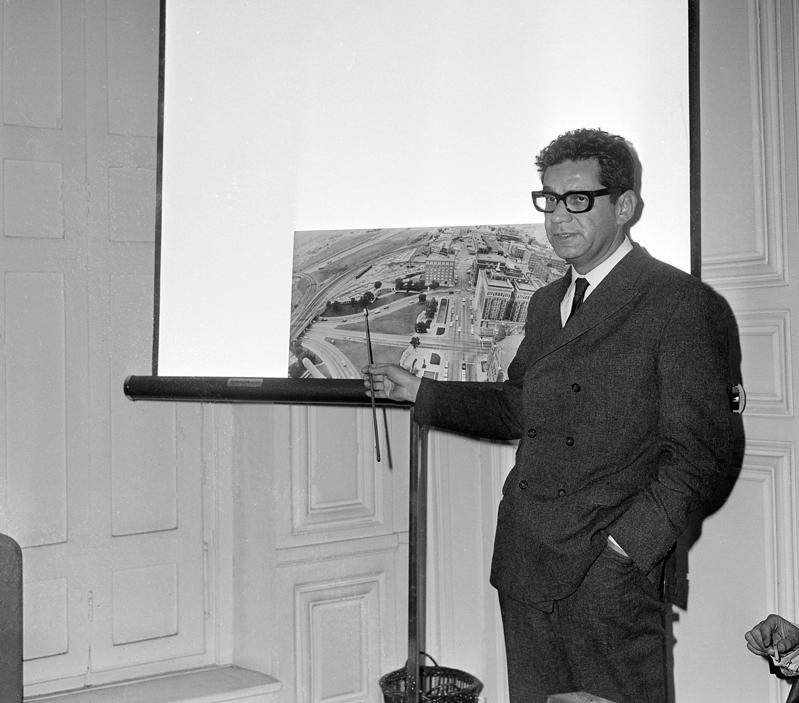
NEW YORK — Mark Lane, the defense lawyer, social activist, and best-selling author who concluded in a blockbuster book in the mid-1960s that Lee Harvey Oswald could not have acted alone in killing President John F. Kennedy, a thesis supported in part by the House Select Committee on Assassinations in 1979, died Tuesday at his home in Charlottesville, Va. He was 89.
The cause was a heart attack, his friend and paralegal Sue Herndon said.
The Kennedy assassination, one of the manifest turning points of the 20th century, also was the climactic moment of Mr. Lane’s life and career. Before the president’s murder in November 1963, Mr. Lane was a minor figure in New York’s legal and political circles. He had organized rent strikes, opposed bomb shelter programs, was a Freedom Rider, took on civil rights cases, and was active in the New York City Democratic Party. In 1960, he was elected a state assemblyman and served one term.
After the Kennedy murder, Mr. Lane devoted much of the next three decades to its investigation. Almost immediately he began the Citizens’ Committee of Inquiry, interviewed witnesses, collected evidence, and delivered speeches on the assassination in the United States and in Europe, where he befriended Bertrand Russell, the British philosopher, one of his early supporters.
By the time President Lyndon B. Johnson appointed the Warren Commission to investigate the assassination, Mr. Lane had emerged as one of its important independent experts. He testified to the commission in 1964 and served as a legal counsel to Marguerite Oswald, the suspect’s mother.
In August 1966, Mr. Lane published the results of his inquiry in “Rush to Judgment,’’ his first book, which dominated best-seller lists for two years. With a trial lawyer’s capacity to amass facts, and a storyteller’s skill in distilling them into a coherent narrative, Mr. Lane asserted that the Warren Commission’s conclusion that Oswald was the lone gunman was incomplete, reckless at times, and implausible.
He coined the term “grassy knoll’’ to describe a green expanse of Dealey Plaza in Dallas that Mr. Lane argued was the source of several of the shots fired at the president.
The book raised doubts about Oswald’s marksmanship and the expertise of police agencies. And he sought to ridicule the Warren Commission’s conclusion that one “magic bullet’’ could strike and grievously injure Kennedy and Governor John Connally and still emerge essentially intact.
Mr. Lane’s findings were disputed aggressively by the government. Still, the financial success of “Rush to Judgment’’ and its conclusions prompted the development of a new assassination genre in nonfiction — by those who believed and did not believe in a conspiracy — that eventually counted more than 2,000 titles.
Mr. Lane was among the genre’s most active contributors. In 1967, the same year he produced a documentary film version of the book, with the same title, The New Yorker magazine writer Calvin Trillin called Mr. Lane one of the foremost Kennedy “assassination buffs.’’ In 1968, Mr. Lane published “A Citizen’s Dissent’’ to respond to the defenders of the Warren Commission report.
In 1973, Warner Brothers released “Executive Action,’’ a feature film based on “Rush to Judgment’’ starring Burt Lancaster that Mr. Lane wrote with help from Dalton Trumbo.
In 1991, Mr. Lane produced a second documentary on the Kennedy assassination, “Two Men in Dallas,’’ and in 1991 he published a second book, “Plausible Denial,’’ that argued the CIA was involved in the Kennedy murder.
Mr. Lane relished the heightened national attention that came with his high-profile causes.
In 1968, the comedian Dick Gregory chose Mr. Lane as his running mate in several states in a write-in presidential candidacy for the Freedom and Peace Party. The campaign collected nearly 50,000 votes.
In its final report in 1979, the House committee went further than any branch of government to support the central points of Mr. Lane’s thesis about Kennedy’s murder. It concluded that the FBI and the Warren Commission investigations of the assassination were flawed.
The committee also found that while Oswald fired three shots, one of which killed Kennedy, a “high probability’’ existed that a second gunman was present and that the president “was probably assassinated as a result of a conspiracy.’’ The committee, though, was “unable to identify the other gunman or the extent of the conspiracy.’’
But Mr. Lane also came under criticism from the committee for providing evidence about the Martin Luther King Jr. assassination that they regarded as unsubstantiated: “In many instances, the committee found that Lane was willing to advocate conspiracy theories publicly without having checked the factual basis for them,’’ wrote the authors of the final committee report. “In other instances, Lane proclaimed conspiracy based on little more than inference and innuendo. Lane’s conduct resulted in public misperception about the assassination of Dr. King and must be condemned.’’
Mr. Lane was undeterred. “It seems clear,’’ he wrote in 1992, “that the people of this nation have a different agenda from the politics of suppression, disinformation, perjury, and subornation of perjury readily embraced by their leaders.’’

