


PARIS — The sky threatened rain, so we ducked into a café. This one, a few blocks from our rented flat in the historic Marais district, was a bright yellow espresso bar with a distinct theme. The proprietors were bike guys.
The place was called Le Peloton — roughly translated, “the pack.’’ The logo, stenciled on the glass storefront, featured a stylish line drawing of a group of competitive cyclists, presumably on the Tour de France. When we asked the owners, Christian and Paul, a question about Vélib’, the city’s bike-sharing system, they gestured out the window at a small cluster of mismatched touring bikes parked along the sidewalk. Why not borrow a couple of ours?
Over two cafes crème, we decided instead to use the city system. If the rain came while we were across town, we would have to make our way back to return the bikes to the café. With Vélib’, we had the option of racking the bikes at another station and jumping in a cab, or on the Metro, to stay dry.
Le Peloton has a few corner shelves devoted to merchandising — cups, T-shirts, messenger bags. We bought a copy of a neat little guidebook, “City Cycling: Paris,’’ and thumbed through it while chatting with the owners.
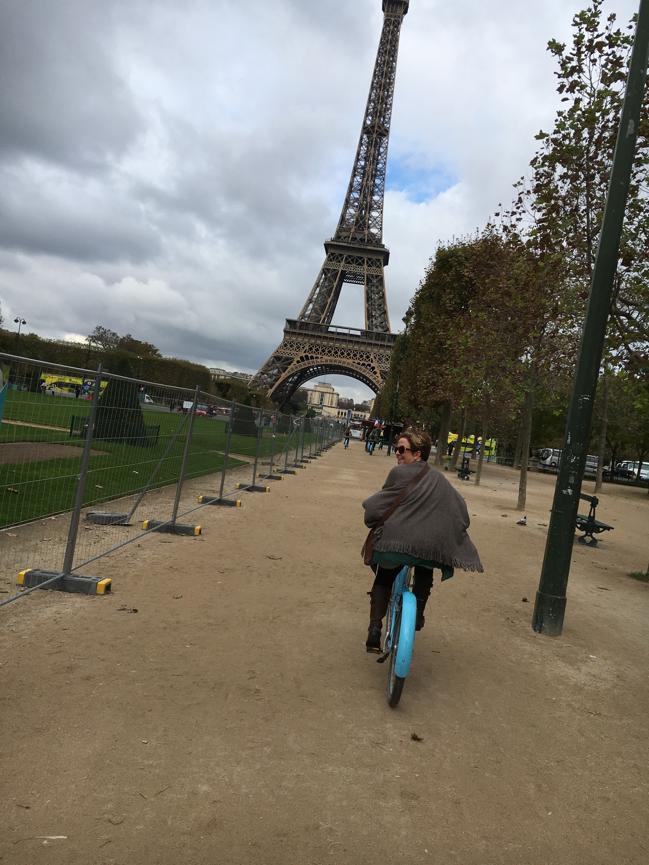
A few days earlier, we’d spent a mild Friday afternoon in the city on a four-hour bike ride (“Best of Paris’’), led by a personable and informative guide with Blue Bike Tours. We’d pedaled past every tourist’s checklist of the city’s grand sites, from Notre-Dame, the Louvre, and the Eiffel Tower to the Champs-Élysées, with a small entourage that seemed hand-picked by Central Casting: a young couple from Mexico and another who were Asian-American, an older pair from Denmark, and a mother-and-daughter team from Canada.
After our guide, Gael, led us for our à la carte lunch break along the Rue Cler, the famous market street on the Left Bank, he made sure to stop on the Pont Neuf, where loved ones by the thousands have been attaching symbolic locks and tossing the keys into the river below. A year ago, Paris officials authorized the removal of an estimated 45 tons of “love locks’’ from the grillwork along the Pont des Arts, another bridge across the Seine, citing safety concerns. So the lock lovers have moved upriver.
Farther down the Seine, he pointed out the gilded copper monument at the north end of the Pont de l’Alma. A quiz: who among us knew what it represented? My wife, bless her heart, joked that it looked like Donald Trump’s hair in the wind. (It’s actually the Flame of Liberty, a replica of the Statue of Liberty’s torch offered to Paris as a commemoration of the enduring diplomatic partnership between the United States and France.)
We’d thoroughly enjoyed the bike tour of the city: how convenient it made the requisite sightseeing, the easy camaraderie among the participants, and the exhilarating feeling of riding a bike in a city of continuous marvels. But when we told our barista, Paul, about the tour, his smiling face soured for the first and only time during our stay in his café.
The Blue Bike people pinched the idea from his own tour company, Bike About Tours, he said. Le Peloton is, in effect, his team’s clubhouse, he explained; their main gig is the tour company, which launched in 2009.
Apparently, there’s been more than a bit of rivalry among the bike tours of Paris. (There’s a third player in the market, Fat Tire Tours, though we did not think to ask whether there’s any bad blood there, too.)
But it’s tough to hang onto a grudge on a bike. “After a long day on my bicycle, I feel refreshed, cleansed, purified,’’ wrote Paul de Vivie, the French cycling pioneer who assumed the pen name Velocio. “I feel that I have established contact with my environment and that I am at peace.’’
We walked a block north, toward Rue Saint-Antoine, to the Vélib’ station (the name translates as “Bike Freedom’’), where we rented two of the service’s bulky city bikes, which are uniformly outfitted with rear mudguards, three gears, and handlebar bells to warn oblivious pedestrians of your approach. Paris now has one of the biggest bike-sharing fleets in the world — there are more than 20,000 of these two-wheelers on the streets — and the city has dramatically increased its number of bike lanes in recent years.
On Sundays, several neighborhoods, many along the Seine, are closed to car traffic. Paris Respire, as the initiative is known — Paris Breathes — lends an additional layer of serenity to the famously crowded city that has perfected the ideal of unhurrying.
We rode our bikes along an aboveground portion of Canal Saint-Martin, the waterway constructed largely under Napoleon’s reign. Then we peeled off and cycled down the boulevard a couple miles southeast, to Père Lachaise, the final resting place of Proust, Piaf, Apollinaire, and the American rock ’n’ roll singer who wrote the lyrics to “People Are Strange.’’
It was about to drizzle, so we deposited the bikes at the station by the main entrance and ducked into the hotel café on the corner. Before we opened the menu we ordered two flutes of champagne, which is how you quench your thirst after a bike ride in Paris.
James Sullivan can be reached at jamesgsullivan@gmail.com. Follow him on Twitter @sullivanjames.

