



Art Review
DANIEL CHESTER FRENCH: THE FEMALE FORM REVEALED
At Boston Athenaeum, 10½ Beacon St., though Feb. 19. 617-227-0270, www.bostonathenaeum.org
The reputation of the New England sculptor Daniel Chester French (1850-1931) rests largely on his portrayals of famous men. The whole world knows his over-life-size sculpture of a seated Abraham Lincoln at the Lincoln Memorial, in Washington.
Nearer to home, in Concord, there is the life-size bronze “Minute Man’’ statue commemorating the opening shots of the American Revolution. (For this commission, which came early in his career, French adapted the pose of the New England farmer from the Apollo Belvedere, in Rome.)
French also sculpted Concord’s most distinguished resident — and for a while his own neighbor — Ralph Waldo Emerson. And he was responsible for the seated statue of John Harvard, the university’s first great benefactor, that continues to function as catnip to tourists in Harvard Yard. (For French, this was an awkward commission, since there were no likenesses of Harvard to work from; instead, he used a contemporary, Sherman Hoar.)
Anyway, as I said, all men. But there was actually much more to French.
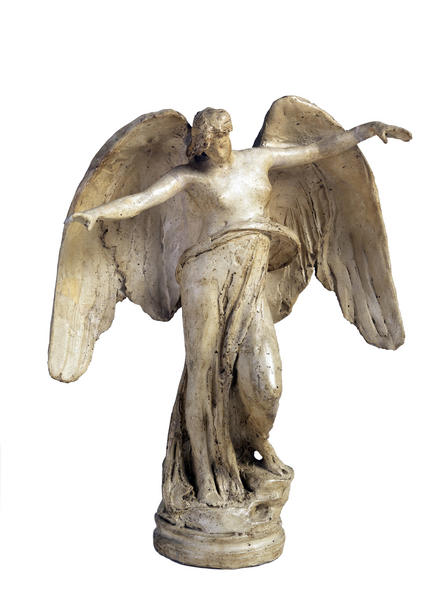
A fascinating exhibit at the Boston Athenaeum, “Daniel Chester French: The Female Form Revealed,’’ steers us away from the cliché of Great Men in bronze and marble toward . . . well, admittedly, another cliché of the period: women, clothed and unclothed, as vessels for allegorical meaning.
The show is worth seeing not only because French was such a superb sculptor, but because it expands our idea of his achievement, and affords all kinds of insights into sculptural process.
Organized by David Dearinger and Donna Hassler, the display boasts an array of models and studies from Chesterwood, the artist’s country home and studio, in Stockbridge. Most were made in preparation for major commissions. They range from 5 inches high to more than 50 inches, and are beautifully set out in the Athenaeum’s intimate yet stately gallery.
To get to the show from Park Street T station, as I did, you have to pass by Augustus Saint-Gaudens’s Robert Gould Shaw Memorial. Somehow, this feels appropriate. French and Saint-Gaudens were the two leading sculptors of the American Renaissance, each magnanimous enough to offer and receive advice from the other.
What’s more, although the subject of the memorial — the soldiers of the Massachusetts 54th Regiment — could hardly be more masculine, Saint-Gaudens’s Shaw Memorial also includes a female figure. Intended to allegorize peace, death, sleep, and remembrance, she hovers ethereally over the marching soldiers.
She is prominent, but not often remarked upon. What seems more admirable about the memorial to modern eyes is the striking realism of Saint-Gaudens’s African-American volunteer soldiers. But the female figure gave Saint-Gaudens more trouble than any other aspect of the work, and he was still making adjustments to her after the rest of the work had been cast.
French, too, worked hard at his female figures. Many of the earliest pieces here are stringently Classical: frontal, compact, somber, static. “Alma Mater,’’ a memorial to the financier and real estate developer Robert Goelet, situated on the steps outside Columbia University’s central library, is the best example.
The memorial itself was designed by the architect Charles McKim (of the firm McKim, Mead, and White). McKim commissioned the sculpture from French. French based the features of the female figure on an up-and-coming actress called Mary Lawton, who was described as “eminently handsome,’’ “stunning,’’ and “Junoesque.’’ Wearing Roman draperies, she is seated symmetrically. Her chair is adorned with lamps symbolizing knowledge and learning.
The various studies for “Alma Mater’’ from Chesterwood, however, reveal that early on in the creative process French had envisaged a less static composition. His other sculptures of seated female figures indulge that impulse.
As Dearinger writes in the catalog, they are generally more Baroque than Classical, their poses more energetic, less symmetrical. The various attributes they carry are positioned to encourage the viewer to walk around them, so that they operate truly “in the round.’’
Of course the academic, Beaux Arts tradition which French epitomized (remarkably, because he was largely self-taught) was close to exhaustion by the time his career took off. Wealthy families and august institutions still wanted bronze and marble sculptures, overflowing with allegories, to honor the dead, uphold virtue, and cement social status.
But for the burgeoning artistic avant-garde, this tradition was largely played out. Its symbolic language was over-evolved, hollowed out by repetition. It was out of touch with contemporary reality.
French, to his credit, moved with the times, if only tentatively. After a crucial trip to France in 1886-87, he returned a better sculptor technically, and began to push himself into realms at once more realistic and spiritual.
That spirituality was expressed in a new exuberance of form. It was most notable in his female figures, which developed more torque and tension, commanding the space around them with more energy and surprise.
Arms jutted out at different angles, bellies pushed forward more sinuously, hips curved provocatively, faces expressed new kinds of alertness, sympathy, and immediacy.
By the 1920s, French’s female forms, although still academic at heart, seemed freshly responsive to the liberated spirit of the time. The best of them convey a sense of lively interior life at odds with the old notion of the female body as an empty vessel to be filled with arbitrary symbolic meaning.
DANIEL CHESTER FRENCH: THE FEMALE FORM REVEALED
At Boston Athenaeum, 10½ Beacon St., though Feb. 19. 617-227-0270, www.bostonathenaeum.org
Sebastian Smee can be reached at ssmee@globe.com.

