


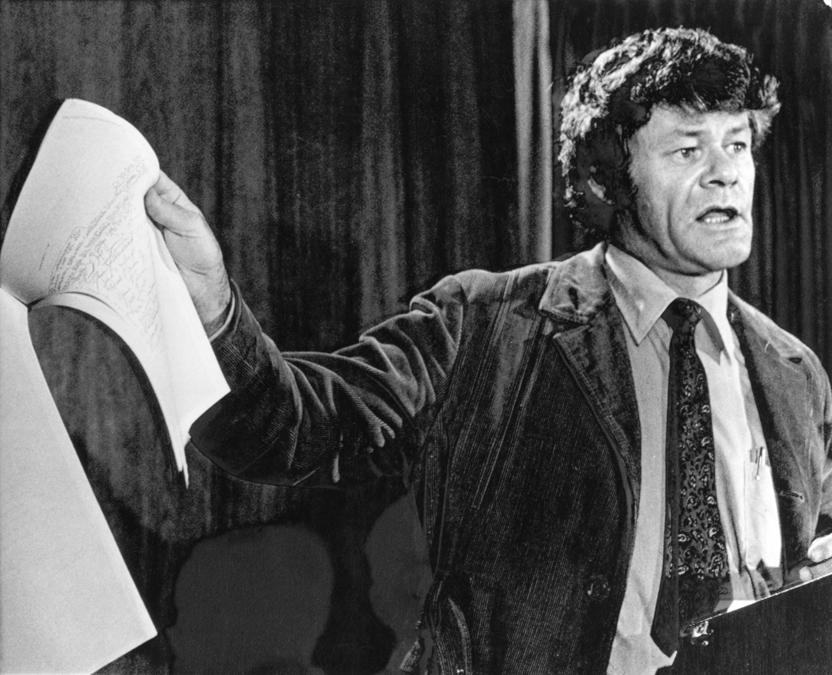
NEW YORK — Donald W. Duncan, a Green Beret master sergeant who came home from Vietnam a disillusioned hero in 1965 and became a leading early opponent of US involvement in a war he called illegal, barbaric, and unwinnable, died in a small town in the Midwest seven years ago. He was 79.
Mr. Duncan’s daughters, Valerie Casey and Luise Wilson, confirmed last week that he died March 25, 2009, at a nursing home in Madison, Ind., an all-but-forgotten soldier.
In an age of seeming information ubiquity, the news media will generally recall the lives of noteworthy people when they die. But Mr. Duncan had lived his last years in obscurity, and his death went largely unremarked upon in the wider world.
His obituary in The Madison Courier said only that Mr. Duncan had once worked for a local nonprofit that helped poor people find jobs. The crucial events of his life — the killings and brutalities of 18 months in Vietnam, the agony of conscience and conversion, and the years of antiwar struggle — had happened long ago and were not mentioned.
In an America torn by protests against the war in the late 1960s and early ’70s, Mr. Duncan was often in the news, although not as prominently as the pediatrician Dr. Benjamin Spock, Roman Catholic priests Daniel and Philip Berrigan, or actress Jane Fonda, who was photographed laughing and applauding on an antiaircraft gun in Hanoi. (Daniel Berrigan died April 30.)
But in 1966, well before the Tet offensive and the My Lai Massacre stirred national discontent, Mr. Duncan was one of the first returning veterans to portray the war as a moral quagmire that had little to do with fighting the spread of communism, as American leaders were portraying it.
Mr. Duncan, who went to war convinced it was an anticommunist crusade, ended his Special Forces duty a changed man. A 10-year veteran, he rejected an offer of an officer’s commission and left the United States Army. Back home, he became a fierce critic of the war, writing articles and a memoir and speaking at rallies across the country with singer Joan Baez, writer Norman Mailer, and comedian Dick Gregory.
In a 1966 article for Ramparts, a radicalized Roman Catholic political and literary journal, Mr. Duncan told of witnessing murders, torture, and other atrocities by US forces in Vietnam in violation of all international laws; of refusing orders at An Khe to kill four enemy prisoners whose hands were tied behind them; and of rapes by South Vietnamese troops that were never reported, let alone punished.
“The whole thing was a lie,’’ Mr. Duncan wrote. “We weren’t preserving freedom in South Vietnam. There was no freedom to preserve. To voice opposition to the government meant jail or death. Neutralism was forbidden and punished. Newspapers that didn’t say the right thing were closed down. People are not even free to leave, and Vietnam is one of those rare countries that doesn’t fill its American visa quota.’’
In his Ramparts articles and a memoir, “The New Legions’’ (1967), Mr. Duncan detailed a military career that began in December 1954, when he was drafted by the Army in Rochester, N.Y., a 24-year-old American who had been born in Canada and raised by a stepfather of Hungarian origin.
“I was a militant anticommunist,’’ Mr. Duncan wrote in Ramparts. “Like most Americans, I couldn’t conceive of anybody choosing communism over democracy. The depths of my aversion to this ideology was, I suppose, due in part to my being Roman Catholic, and in part to the stories in the news media about communism. My stepfather was born in Budapest, Hungary. Although he had come to the United States as a young man, most of his family stayed in Europe.’’
He volunteered to fight in South Vietnam in 1964 and served in missions all over the country with the Fifth Special Forces Group. He killed the enemy, saw comrades killed, watched civilians shot and bayoneted and their villages burned. He won South Vietnam’s Silver Star, the US Army Air Medal, two Bronze Stars, and the Combat Infantry Badge, and was recommended for a Silver Star and the Legion of Merit.
On reconnaissance in Laos, where US bombers were pounding an enemy supply route, he began to doubt American reports on the war.
“This mission confirmed that the Ho Chi Minh Trail, so called, and the traffic on it, was grossly exaggerated,’’ he said, “and that the Viet Cong were getting the bulk of their weapons from ARVN and by sea. It also was one more piece of evidence that the Viet Cong were primarily South Vietnamese, not imported troops from the North.’’ (The ARVN was South Vietnam’s Army.)
Mr. Duncan said it had been common knowledge that draft-dodging and desertion rates among South Vietnamese troops were “staggering,’’ and that Viet Cong guerrillas attacked US machine-gun positions “across open terrain with terrible losses.’’ American propaganda, he said, could not obscure such lopsided motivations.
“Even during the short period I had been in Vietnam,’’ he wrote, “the Viet Cong had obviously gained in strength. The government controlled less and less of the country every day. The more troops and money we poured in, the more people hated us.’’
He concluded that the United States was destined to lose the war. “I don’t think Vietnam will be better off under Ho’s brand of communism,’’ he said. “But it’s not for me or my government to decide. That decision is for the Vietnamese. I also know that we have allowed the creation of a military monster that will lie to our elected officials, and that both of them will lie to the American people.’’
Donald Walter Duncan was born in Toronto on March 18, 1930, to Walter Cameron Duncan and the former Norma Brooker. Little is known of his early life. His father died when he was young, and his mother married Henry de Czanyi von Gerber, a naturalized American who became a noted cellist and orchestra conductor. His father’s daughter, Frances (Donald’s stepsister), became actress Mitzi Gaynor.
As a young man, Mr. Duncan was an office clerk, lumberjack, foundry worker, and tree-topper. He married, had a child, and divorced before being drafted. In West Germany in 1955, he married Apollonia Roesch. Their daughters are Valerie and Luise. After a second divorce, he married and divorced several more times. Besides Casey and Wilson, he leaves at least two grandchildren and Gaynor.
After Mr. Duncan’s antiwar activities, he lived in Berkeley, Oakland, and elsewhere in California. His daughters then lost track of him for years. He settled in Indiana around 1980, and in 1990 he became a founder of River Valley Resources, which provides services for the poor.
“Dad did not talk a whole lot about the war,’’ Wilson recalled. “But he was involved in a lot of antiwar things. We were young, but he wanted us to understand. He instilled in Val and me a sense of what’s right.’’

