


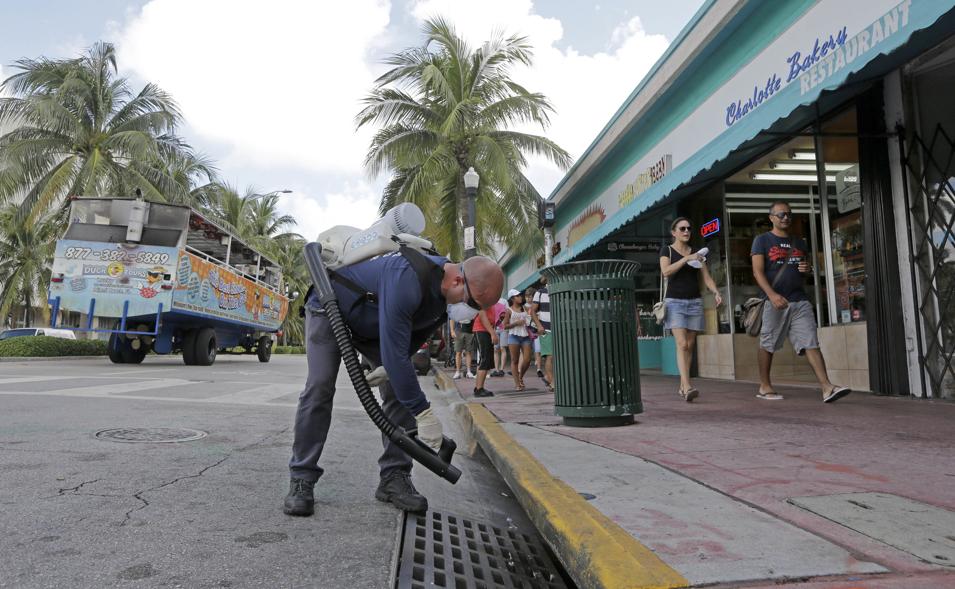
WASHINGTON — Florida state officials on Tuesday reported five new cases of Zika, four more in the Wynwood neighborhood of Miami where the first locally transmitted cases in the country were reported and the fifth on the other side of the state in Pinellas County.
It’s the last case that’s the most worrisome because it might signal mosquitoes infected with the virus are spreading. But it’s too soon to know, officials said.
Florida Governor Rick Scott and the Centers for Disease Control and Prevention have yet to issue a travel advisory for the Pinellas area to indicate that there is active local transmission.
Officials said the person with Zika in Pinellas, which includes the city of St. Petersburg, had not traveled internationally but that investigators are looking into the possibility that the virus may have been acquired in a neighboring county.
Anthony Fauci, director of the National Institute of Allergy and Infectious Diseases, said Sunday that he believes Texas and Louisiana could be hit with local transmissions of Zika next and that the virus could be in United States for one to two years.
The CDC has urged pregnant women to consider avoiding Miami’s Wynwood and South Beach areas but this week the areas still remain crowded with tourists.
In interviews with the Washington Post and other news media, some visitors shrugged at the travel advisories. ‘‘We really haven’t taken any precautions whatsoever,’’ one man said. ‘‘I guess we should, shouldn’t we?’’
Zika can cause severe brain-related birth defects in babies, including a dangerously small head and other brain defects, if women are infected during pregnancy.
In other cases, the virus can lead to Guillain-Barre, which can cause temporary paralysis and in rare instances, death.
Scott announced that the Florida Department of Health is allocating another $5 million in funding to Miami-Dade County for Zika preparedness and mosquito control.
On Monday, US Representative Debbie Wasserman Schultz and Miami Beach Mayor Philip Levine asked for more federal resources to combat Zika’s spread in South Florida, where the first cases of the virus transmitted by mosquito bites on the US mainland have been found in the neighborhoods of South Beach and Wynwood.
The mayor said ‘‘we need the federal government to step up.’’
President Obama requested an emergency $1.9 billion in February for mosquito control and vaccine development. But lawmakers left Washington for their summer recess without approving the money after Republicans tied the funding to a dispute over abortion.
Fauci said on ABC’s ‘‘This Week’’ that Florida and other Gulf Coast states, including Texas and Louisiana, are most vulnerable to the spread of the disease in the United States. He said the heavy flooding in Louisiana has increased standing water, where mosquitoes thrive.
The Zika virus has spread widely through Latin American and the Caribbean.
The Aedes aegypti mosquito is the main transmitter of the virus.
At the current rate, Zika is on course to infect more than 90 million people around the world in the first wave of the epidemic, according to a study published last month in the journal Nature.
That includes about 2 million women of childbearing age, and it could result in tens of thousands of babies born with severe birth defects.
The discovery last week of non-travel-related infections in Miami Beach prompted the Centers for Disease Control and Prevention to expand its travel warning for pregnant women to include the area known for nightclubs, pedestrian thoroughfares, and beaches, as well as Wynwood, a neighborhood known for art galleries and boutiques.
Fauci said mosquito control is the best way to stop the spread of the Zika virus.
‘‘With our experience with other similar viruses like dengue, this is something that could hang around for a year or two,’’ Fauci said. ‘‘Hopefully, we get to a point to where we could suppress it so that we won’t have any risk of it.’’
Meanwhile Mayor Levine said Miami Beach workers are doing everything in their power to go after mosquitoes in the popular tourist destination.
He told New York radio station AM 970 that services in Miami Beach are running smoothly, despite the Zika concerns.
“We have contained the small little outbreak of Zika, which was very limited,’’ he added. ‘‘It’s something we’re watching. It’s closely contained and it certainly hasn’t disrupted the business of Miami.’’
More than 15.5 million people made overnight visits to Miami and nearby beaches in 2015, with an impact of $24.4 billion on the local economy, according to figures from the Greater Miami Convention and Visitors Bureau.

