


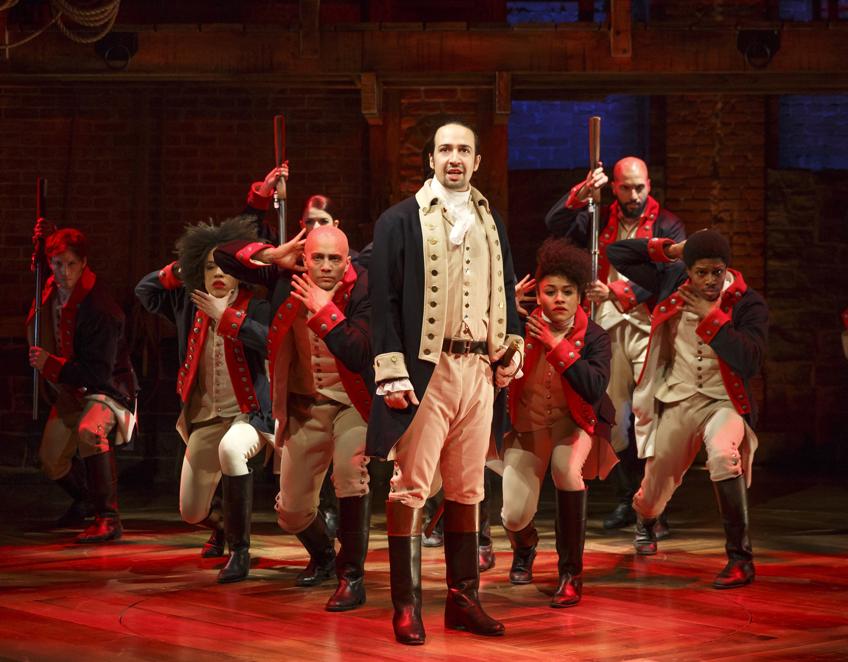
‘We’re gonna teach ‘em how to say goodbye,’’ sings George Washington in the Broadway phenomenon “Hamilton.’’ He means the American people, panicked at his leaving office: “If I say goodbye, the nation learns to move on/It outlives me when I’m gone.’’ Goodbyes have just befallen the show, too. On July 9, creator and star Lin-Manuel Miranda left the cast, along with Leslie Odom Jr. (Aaron Burr) and Phillipa Soo (Hamilton’s wife, Eliza). Like the nation, the audience will outlive these leave-takings. And how lucky we are to be alive right now, because at least there’s a fresh cast of books on Hamilton, from this year and last.
First, though, let’s give it up for the original source. In 2008, Miranda began reading Ron Chernow’s magnificent “Alexander Hamilton’’ (Penguin, 2004) during a vacation in Mexico. Soon, he was making up hip-hop lyrics to this founding father’s high-wire narrative: “[B]astard, orphan, son of a whore and Scotsman/ dropped in the middle of a forgotten spot in the Caribbean,’’ who quits St. Croix for New York, marries up, and rises up to become General Washington’s right-hand man, then writes terrifically, prolifically (27-plus volumes worth, including two-thirds of the Federalist Papers essays). Next, he launches many of our institutions (national bank, customs service, and more), only to succumb to the nation’s first tabloid sex scandal and die in its most famous duel.
Chernow was a consultant on the show and has said that Miranda is a genius of “compression and economy.’’ Just so: Chernow spends many pages chronicling the enmity between the philosophical Secretary of State Thomas Jefferson and the more practical Secretary of the Treasury Hamilton on states’s rights vs. federal oversight, agrarian vs. urban economy, etc. In the song “Cabinet Meeting #1,’’ Miranda nails Hamilton’s disdain: “Thomas. That was a real nice declaration./ Welcome to the present, we’re running a real nation.’’ Chernow is trenchant too, though less acid: “If Jefferson provided the essential poetry of American political discourse, Hamilton established the prose of American statecraft.’’
The musical’s game-changing, sometimes fraught father-son relationship fires up “Washington & Hamilton: The Alliance That Forged America’’ (Sourcebooks, 2016). Two historians, Canton resident Stephen F. Knott and Tony Williams, cover the pair’s shared depths of ambition and honor, plus their battlefield-deepened bond. (Hamilton was Washington’s aide-de-camp, and they often shared the same tent). After the war, each recognized that America couldn’t prevail as a loose confederation and set to getting the Constitution ratified, Washington by his granitic authority, Hamilton by writing the Federalist Papers.
“My boy,’’ Washington called Hamilton. But when he calls him “son’’ in the show, the younger man bristles, “Don’t call me son.’’ Indeed, the two had a falling out that gets the full color commentary here. Still, “the pen for our army was held by Hamilton,’’ said one peer. The bastard/orphan even helped compose the president’s eloquent farewell address. I smiled when I hit one of the general’s letters, wondering which man penned this opinion of New Englanders: “They are an exceeding dirty and nasty people.’’
A quintessential New Englander, the wonderful writer John Sedgwick, presents this next bit of Hamiltonia, “War of Two: Alexander Hamilton, Aaron Burr, and the Duel That Stunned the Nation’’ (Berkley, 2015). It begins with a letter — written the night before that duel — from Hamilton to Theodore Sedgwick (John’s “great-great-great- grandfather’’), then speaker of the House. This personal connection galvanizes the book, whose title echoes the Latin derivation of duel, duo bellam, or “war of two.’’
In the show, Burr counsels Hamilton to “Talk less./ Smile more.’’ Good advice, as Sedgwick’s book bears out, for each encumbered phrase numbers his days. Hamilton calls Burr “dangerous’’ at a gathering, and one gossip adds that Hamilton uttered a “still more despicable opinion.’’ Worse though, he’d compared Burr to Catiline, the morally bankrupt ancient leader who betrayed the Roman republic. As any classicist legislator knew, them’s fightin’ words. But Hamilton would be vindicated: “Burr’s great cause was only Burr,’’ writes Sedgwick, and later he’d try to goad part of the Western territory to secede — and crown himself emperor.
And now the moment you’ve all been waiting for: “Hamilton: the Revolution’’ (Grand Central, 2016), a coffee-table book printed like a broadside, by Miranda and Jeremy McCarter. What a sumptuous delectation, that comes with such annotation.
Meaning the full 42,000-word libretto, with tons of marginalia. (Who knew that actor Hugh Laurie coined the title for King George III’s Brit-pop breakup song, “You’ll Be Back’’?) Note the shout-outs to such diverse sources as “South Pacific,’’ Busta Rhymes, “The Pirates of Penzance,’’ Jay Z, and “Macbeth,’’ and many insightful chapters on the origins, creators, and (yes) revolutionary impact of “Hamilton.’’ I ate it all up with a spoon as the songs soared through my headphones. In these days of goodbyes, what a good buy.
Katharine Whittemore can be reached at katharine.whittemore@ comcast.net.

