


New York native, Harvard grad, and current Paris resident Whit Stillman is not a prolific filmmaker.
Before his newest feature, “Love & Friendship,’’ an adaptation of Jane Austen’s posthumously published novella “Lady Susan’’ that opens on Friday, he’d only made four films in 25 years. Three art house darlings — “Metropolitan,’’ “Barcelona,’’ and “The Last Days of Disco’’ — were followed by a 13-year fallow period, when scripts were completed but independent money was scarce.
His 2011 return to writing and directing, “Damsels in Distress,’’ bombed at the box office, but by that time, Stillman was already ensconced in his long percolating Austen project. They’re a rather perfect matchup.
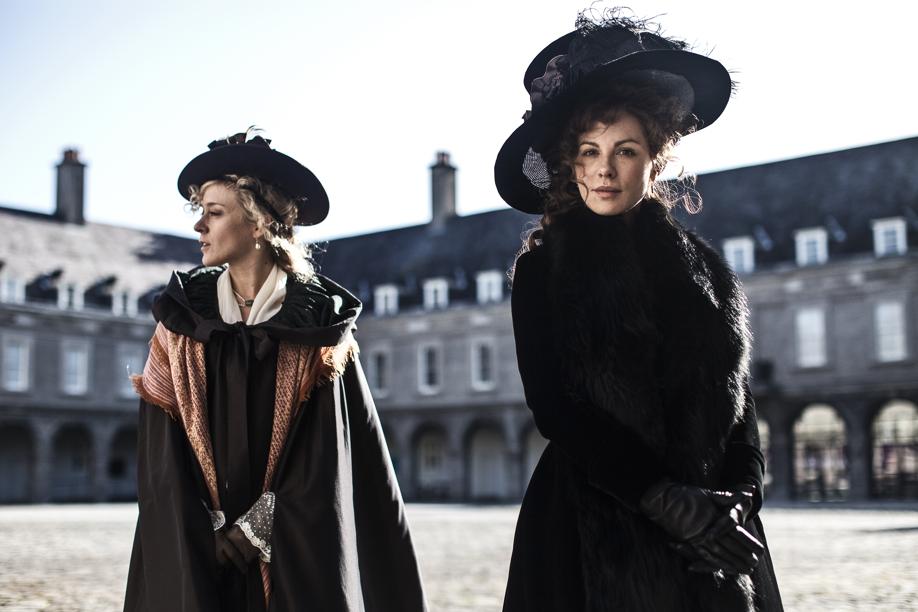
Austen didn’t exactly churn out novels; only four were published, along with some novellas and short stories, in her short life. But both she and Stillman share a penchant for infusing their work with biting humor and studies of characters’ foibles. “Love & Friendship’’ tells of a beautiful young widow and single mom, played by Kate Beckinsale, who proves to be equal parts charming, selfish, and conniving as she attempts to seduce her way through British society.
Stillman, 64, had acting ambitions in his high school days, but turned to writing at Harvard. As a legacy admit — his father and grandfather went there — he was a theater critic for the Harvard Crimson, and he wrote two scripts for Hasty Pudding shows, both of which were rejected. Post-graduation, he decided he didn’t have the stamina to be a novelist, and couldn’t find any open avenues to his dream of writing for film or TV. It took a series of jobs in book publishing, then a move to Spain, to put him on track for his up and down and now up again career.
Stillman visited Boston recently to talk about the new film and make some confessions about his thoughts on Jane Austen.
Q. You’ve said before that Spain is where you got your start in filmmaking. What happened there?
A. I got engaged to a Spanish girl, and when I went there to get married, I met a lot of Spanish producers and directors at a dinner party, and convinced them to let me represent their films as a sales agent, even though I really wanted to be a director. The industry there is so informal, I was asked to act, sort of playing myself, in a film for a director client. Then I had a real role in a Fernando Trueba film, where I played Dr. Mortimer Peabody, an obnoxious American psychiatrist. So while I was doing that, I got to learn how they made films on low-budget and medium-budget levels.
Q. The first few films you made had large autobiographical components. What brought you around to adapting Jane Austen?
A. Actually, I didn’t like Jane Austen at first. I read “Northanger Abbey’’ when I was a sophomore at Harvard, and I hated it. I told everyone that Jane Austen was bad and overrated. Then four years later I had the chance to read “Sense and Sensibility,’’ and I loved it. I later saw an edition of “Northanger Abbey’’ and I decided to give it another chance. I bought it and I liked it, and the novella “Lady Susan’’ was published as an appendix in that edition. That’s where I discovered it.
Q. Did you immediately think it would make a good film?
A. I certainly thought it was interesting. I spoke with my friend Trevor Brown, who was active in theater in London and wanted to get into film, and asked if he thought there was anything in the novella. He did, and we talked about doing it. I started writing it, but he moved to New York and I was left alone on the project. That was around 2004.
Q. The book is very short and is written in epistolary form (told in letters between people, rather than as a narrative). What was your approach to adapting it?
A. It was really challenging, really intimidating. The idea was to take the letters and intersperse them, like a deck of cards. You turn them into conversations, get masses of material, and then you don’t look at the novel anymore; you just look at your script and you whittle it down. Then I just tried to build up other things that weren’t in the novel. The novel describes Lady Susan seducing Reginald De Courcy, but you don’t really know what they say to each other.
Q. Lady Susan is kind of nasty. Do you like her?
A. I got to like her, sort of in the way you like the guys in “Dirty Rotten Scoundrels.’’
Q. Is it true that you were in line to direct “Sense and Sensibility?’’
A. Yes, I was offered that film in 1994. I was finishing the editing of “Barcelona’’ and I already had the idea of doing “The Last Days of Disco.’’ The producer Lindsay Doran first offered it to Rob Reiner and then to me. I read an early draft of the script that Emma Thompson had written, and then I reread the novel. I noticed that in her adaptation, she had not put in the information of the first two narrative chapters. But a lot of what was really compelling to me was established in that narration. So I passed on it, but when I finally saw Ang Lee’s film, I loved it.
Interview was edited and condensed. Ed Symkus can be reached at esymkus@rcn.com.

