


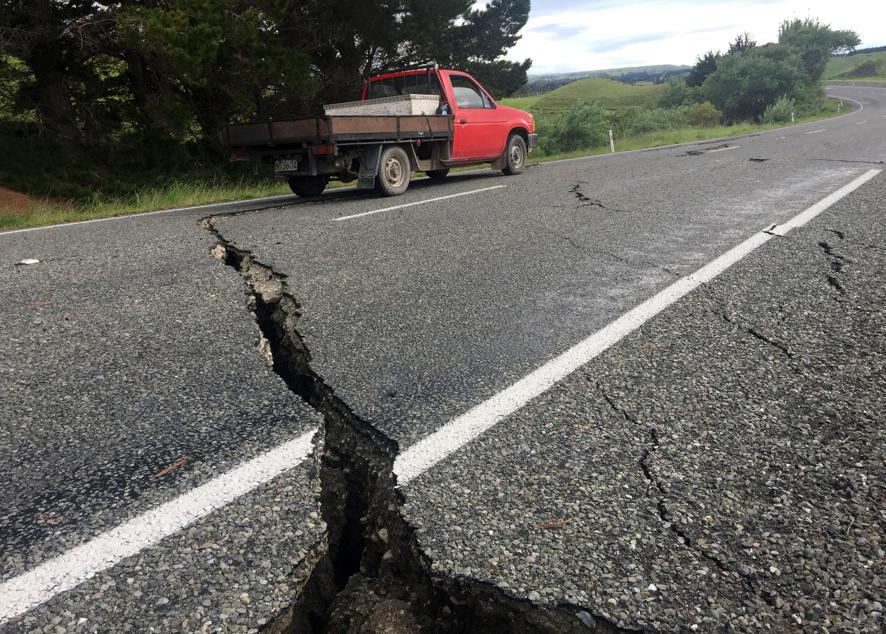
SYDNEY — A powerful earthquake measuring 7.8 magnitude hit the east coast of New Zealand’s South Island just after midnight Monday, triggering multiple aftershocks and tsunami waves and killing at least two people, officials said.
The Ministry of Civil Defense and Emergency Management warned people living near the coast to move inland to higher ground as tsunami waves raised seawater levels in some places by about 6 feet. Officials in Wellington, the capital, urged people to stay out of its central business district until the risk of damage to buildings could be assessed.
Prime Minister John Key said the earthquake had killed at least two people, Reuters reported.
“We don’t have any indications at the moment to believe it will rise, but we can’t rule that out,’’ Key, speaking to reporters in Wellington, said of the death toll.
In a televised interview, he said, “It’s not unusual to get quakes here, but then it started building in its intensity.’’
Glasses broke and furniture moved at Premier House, the official prime ministerial residence in Wellington, Key said. He had stayed there overnight after meeting with Secretary of State John F. Kerry, who was on a state visit there and to Antarctica.
The quake temporarily knocked out New Zealand’s emergency call number, 111, the Associated Press reported. In Wellington, it collapsed a ferry loading ramp, broke windows, and caused items to fall from shelves.
The New Zealand Herald reported that one of the deaths had resulted from a heart attack and that another had taken place on a historic homestead near the beach town of Kaikoura, a popular destination for tourists on whale-watching expeditions. Military helicopters flew to the seaside town early Monday to assess the damage after roads were destroyed.
“There are some reports of casualties in the Kaikoura area, but just exactly what the extent of that is, is not yet reported,’’ Gerry Brownlee, the country’s acting minister of civil defense, told reporters.
The earthquake struck about 50 miles southwest of Kaikoura and 50 miles north of Christchurch.
Elliot Fim, a regional official in Christchurch, said in a telephone interview that there were no reports of damage, injuries, or fatalities. The Fire Department was dealing with a large number of emergency calls seeking assistance.
Fim said people living along about 200 miles of coastline had been evacuated. Some roads and a building were reported damaged, but people were able to move to high ground. A spokesman for the Wellington Region Emergency Management office said there were reports of minor damage in the capital city.
One of Wellington’s newest hotels, the Sofitel, had minor damage. Members of Kerry’s staff, some of them still in the city after his departure, had to evacuate the hotel in the middle of the night.
On Monday morning, emergency crews were assessing damage to city buildings. “We are still having aftershocks,’’ a spokeswoman for Key said. Schools and shops remained closed.
Dan Jaksa, a duty officer from Geoscience Australia, said that if the small townships north of Christchurch did not have earthquake-resistant buildings, “it is going to be tough.’’
In 2011, an earthquake measuring 6.3 devastated Christchurch and killed 185 people. An additional 164 people were seriously injured. The latest earthquake was about 40 to 50 times as large as the one in 2011, Jaksa said.
In Cheviot, a small town thought to be close to the epicenter, there were no reports of casualties.
“There is minimal damage to buildings that we can see,’’ Grant Burnett, the chief of the Cheviot volunteer fire brigade, said in a telephone interview. “It is surprising, because it was a big quake.’’
Burnett said that some properties along the coast had been evacuated, but that none had been seriously damaged by the surge in seawater. The fire brigade went door to door to check on residents, especially the elderly, he said.
Jaksa said the earthquake had ruptured from west to east, with shocks moving toward Wellington, on the southern coast of New Zealand’s North Island. “Let’s hope this is it, and there’s no more,’’ he said.
After the initial shock, which the US Geological Survey measured at 7.8, there was an aftershock measuring 6.1, and then several more shocks, with three of those measuring in the high fives, Jaksa said. The earthquake occurred in the Hikurangi Trench, a subduction zone where one tectonic plate slides under another.
New Zealand’s North Island and the northern part of its South Island are on the Pacific plate, which is moving west, while the Australian plate is largely moving north.

