


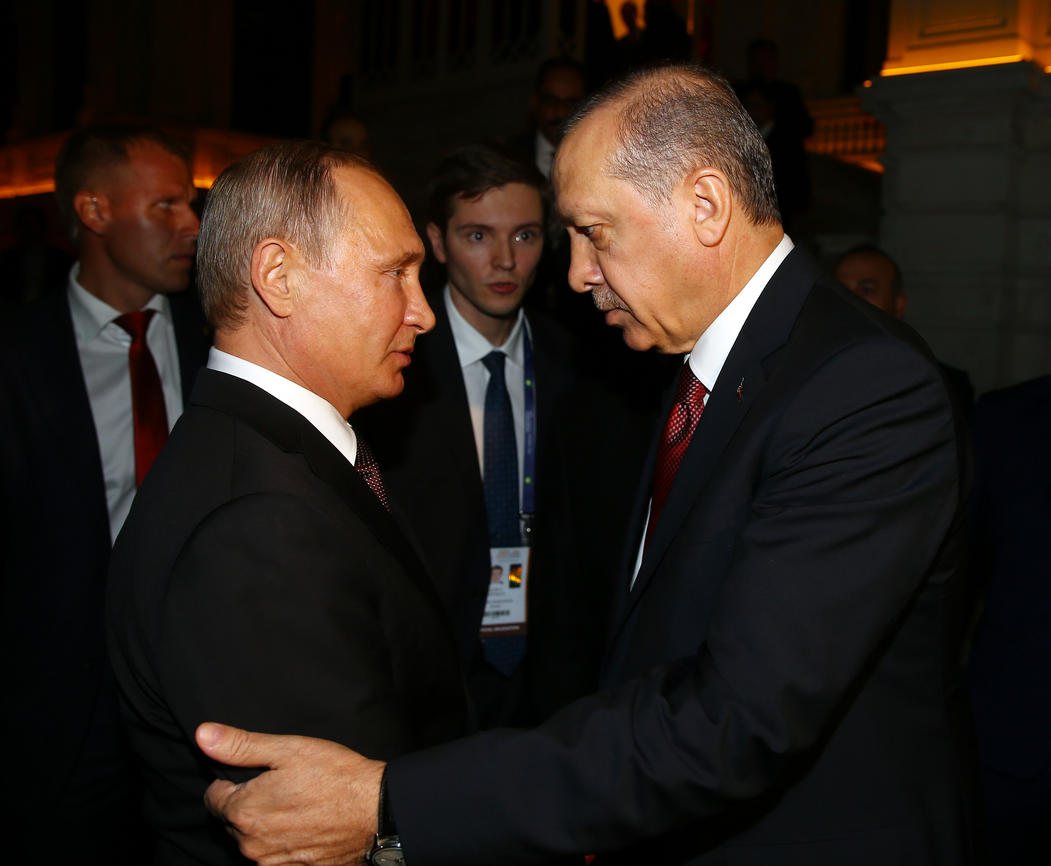
MOSCOW — Amid increasingly tense relations with the United States over Syria, President Vladimir Putin took advantage Monday of a routine meeting in Istanbul to advance the Kremlin’s reconciliation with Turkey.
His appearance at an energy conference was his first visit to Turkey since a crisis in relations between the countries after Turkey’s downing of a Russian fighter jet along the border with Syria in November 2015, in which a Russian pilot was killed.
President Recep Tayyip Erdogan of Turkey, nominally an ally of the United States in Syria, patched things up with a letter of apology and a trip to St. Petersburg, Russia, in August.
The two presidents have sought to use their warming relationship both at home and abroad to indicate that they are not politically isolated and remain central players in any Syria solution.
They sat next to each other in the front row of the World Energy Congress in Istanbul, laughing together, and later met for bilateral talks.
Both men have had recent troubles with Washington. The United States broke off cooperation with Moscow over Syria and then accused the Kremlin of war crimes. Erdogan has been criticized by Washington for using the aftermath of a July coup attempt to introduce a sweeping crackdown against a wide array of critics, going well beyond the coup plotters and their backers.
Turkey and the United States have also been at odds over the Kurds, whom Erdogan considers terrorists and a national security threat. Washington relies on the Syrian Kurds as its main ground force in the fight against the Islamic State militant group.
Putin has been far more supportive of the Turkish leader’s behavior since the coup attempt. The Russian president has also long sought to exploit any cracks in NATO, of which Turkey is a member.
Anna V. Glazova, head of the Asia and Middle East Center at the Russian Institute of Strategic Studies, noted that Putin could easily have sent a minister to the Istanbul summit.
“This means that he wanted to discuss regional problems with Erdogan face to face,’’ Glazova said. “This becomes especially important in the context of Russia’s current tensions with the US.’’
Erdogan suggested earlier this month that Turkey would propose ways to revive the cease-fire in Syria that collapsed amid mutual recriminations between Russia and the United States. Ankara would also like both the United States and Russia to support the establishment of a no-fly zone along the border that would eventually be used as a protected area to settle millions of refugees.
No breakthrough is expected from the current meeting, however. When the two presidents met in August in St. Petersburg in the first attempt to restore their lost rapport, the need for a cease-fire in Syria was the main point of agreement.
Both have also expressed a commitment to restoring robust trade ties that were severed after the fighter was shot down, although some differences remain.
Russia had once pledged to build TurkStream, a gas pipeline intended to supply Europe and meant to bypass a route across southern Europe that the European Union had blocked. Putin said on Monday that the two sides were still negotiating to restore the project.
Russia banned the import of almost all Turkish agricultural produce, and Turkey would like them restored.
The main point of the gathering in Turkey Monday was the oil industry. Putin also met on the sidelines with leaders of various producing states like Venezuela. In his speech, Putin said that Russia was prepared to participate in an agreement on production cuts to try to shore up the price of oil.
Turkey and Russia continue to back opposite sides in Syria’s civil war. Russia has used mostly its air force to back President Bashar Assad of Syria. Turkey has backed the rebels within certain limits; it does not want to see Kurdish power expand.

