


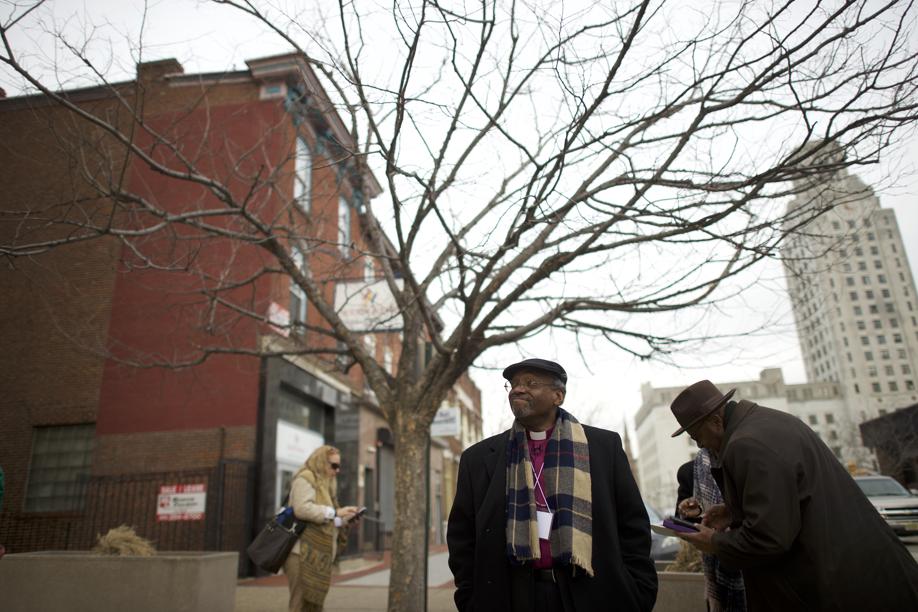
NEW YORK — When Michael B. Curry was installed in November as the 27th presiding bishop of the Episcopal Church, he spoke of racial reconciliation and finding new ways to spread the teachings of Jesus.
His appointment as the first African-American leader of a predominantly white Protestant church that has long been associated with the US elite elevated the voice of a preacher who had focused his ministry on racial justice.
Curry’s tenure began after the Episcopal Church decided to bless same-sex marriages, and in January, he defended that decision in a meeting with archbishops of the Anglican Communion, many of them from Africa, who vehemently oppose gay marriage.
Curry, 63, who recently recovered from surgery related to a head injury, was interviewed this month at the Episcopal Church’s headquarters in New York. This interview has been condensed and edited.
Q: Your father was also an Episcopal priest, but before that he was a Baptist. Why did he become an Episcopalian?
A: He was dating my mother, who was an Episcopalian, and he went to church with her at some point. When it came time for Communion — in the Episcopal Church people drink out of the same cup. They were one of the only black couples sitting in the congregation, and this was in the late ’40s in southern Ohio. It just hit him that any church where people of different races drink from the same cup knows something about the Gospel and he wanted to be a part of that.
Q: In your career as a priest, as a bishop, have you experienced racism within the church?
A: When I was in seminary, the expectation at the time was that if you were a black priest or seminarian, you were going to be serving in black churches. There was a black church world and a white church world. That was the given-ness of racism, not that anybody said anything.
Q: So here you are, the first black presiding bishop of a predominantly white denomination. How big a deal is that?
A: I’m aware of that, but it doesn’t influence me day to day. But if you ask what are the driving passions and convictions of Michael Curry? I have a fundamental, Christianized, free disposition for working to create a church and a world where there is room for everybody.
Q: At the last General Convention, in which you were elected, the church decided to make racial reconciliation a top priority. You’re on a small committee charged with figuring out concrete steps. What are the plans?
A: Laws can change behavior, and must change behavior, but laws don’t change hearts. We’ve got to be about the work of changing and transforming hearts. And that happens by deepening real sustained relationships, and sharing of our life stories.
Q: At a meeting of Anglican leaders in January, you tried to make the connection between the exclusion and bigotry experienced by black people and the exclusion of gay people. Yet the primates still voted overwhelmingly to sanction the Episcopal Church.
A: I knew that was coming. But I wanted them to know, and I meant that sincerely, that this love of God is big enough to embrace all of us, and even embrace us in our disagreements. Love is big stuff, and it can save us all.

